
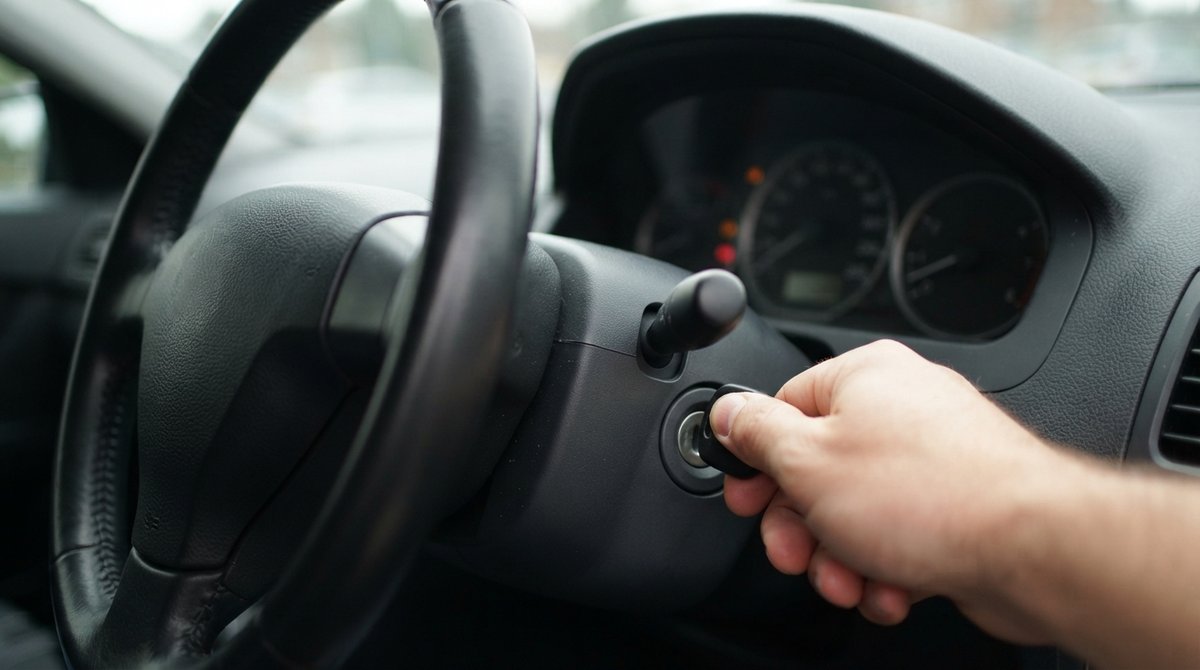
When your key won’t turn in ignition, the cause is usually something simple: the steering lock has engaged, the car isn’t fully in Park, or the key is too worn to line up the lock’s pins. A few gentle checks fix most cases in under a minute. What you should never do is force the key, because a snapped key in the ignition turns a free fix into a locksmith call.
In this guide
| What you notice | Most likely cause | First thing to try |
|---|---|---|
| Key won’t turn and the steering wheel feels locked | Steering lock engaged | Wiggle the wheel while turning the key |
| Automatic car, key won’t turn back to remove it or won’t start | Not fully in Park | Move the shifter firmly into Park |
| Key turns sometimes, worse over time | Worn key | Try the spare key |
| Spare key also sticks | Worn ignition cylinder | Have the cylinder repaired or replaced |
| Key goes in but feels gritty | Dirt or debris in the lock | Clean with electrical contact cleaner |
| Stiff only on freezing mornings | Cold or moisture in the lock | Warm the key, use lock de-icer |
| Key looks bent or chipped | Damaged key | Have a new key cut from the code |
Why the key won’t turn in ignition
1. The steering lock is engaged
This is the most common cause. Turning the wheel after switching off can engage a locking pin, and pressure on the wheel jams it against the ignition. Fix: gently turn the steering wheel left and right while turning the key at the same time. You’ll feel the point where the wheel moves slightly and the key turns. The wheel usually only needs to move a little in one direction, so if it won’t budge one way, try the other.
2. The car isn’t fully in Park
Automatic cars won’t let the key turn to start, or come out of the ignition, unless the shifter is fully in Park. Push the shifter firmly into Park, or try Neutral. A worn shifter linkage or a failing brake-shift interlock can cause the same symptom repeatedly.
3. A worn key
Keys wear down over years of use, especially if they share a heavy keychain. Worn cuts don’t line up the small pins (wafers) in the lock. Compare it with the spare. If the spare works smoothly, the original key is the problem.
4. A worn ignition lock cylinder
If both keys stick, the cylinder’s wafers are worn. It often starts as an occasional problem, then becomes daily. A locksmith or shop can rebuild or replace the cylinder. A rebuilt cylinder can often be keyed to your existing keys, so you don’t need a new set.
5. Dirt or debris in the lock
Grit and pocket lint get into the keyway over time. A short burst of electrical contact cleaner, then a puff of dry graphite lubricant, can free it. Avoid sticky oils, which collect more dirt. A heavy keychain swinging from the key also wears the cylinder faster, so keep extra keys on a separate ring.
6. Cold weather or moisture
Water in the lock can freeze on cold mornings. Warm the key in your hand or use a lock de-icer, the same fix as for a car door frozen shut. Never heat the key with a flame.
7. A damaged or wrong key
A bent or chipped key, or a key copied badly, won’t turn reliably. A dealer or locksmith can cut a new key from your car’s key code.
What to do, step by step
- Make sure it’s the right key and it’s fully inserted.
- Move the shifter firmly into Park, or Neutral for a manual, with the clutch pressed if needed.
- Wiggle the steering wheel gently while turning the key.
- Try the spare key.
- Clean the keyway with electrical contact cleaner and a little graphite lubricant.
- If nothing works, call a locksmith or roadside assistance rather than forcing it.
If the key turns but the car still won’t start, see our guides to a car that won’t start but the lights work and a car that clicks but won’t start. If a warning light stays on once it runs, look it up in our OBD2 code lookup, or use the car symptom checker.
How much does it cost to fix?
| Repair | Typical cost |
|---|---|
| Freeing the steering lock | Free |
| Lock de-icer or graphite lubricant | $5–$15 |
| New cut key (no chip) | $10–$30 |
| New transponder key, programmed | $100–$350 |
| Ignition cylinder rebuild | $100–$250 |
| Ignition cylinder replacement | $200–$500 |
| Brake-shift interlock or shifter repair | $100–$400 |
Is it safe to keep trying?
Yes, gently. Don’t use pliers or force, because a broken key or a damaged cylinder costs far more to fix. If the key gets stuck in the “on” position while driving, or the car shuts off when you hit a bump, have the ignition switch inspected right away, because a failing switch can cut the engine. Some ignition switches have been recalled for exactly this problem, so check the NHTSA recall lookup for your car.
FAQ
How do I unlock my steering wheel to turn the key?
Turn the wheel gently in both directions while turning the key. The lock releases once the pressure comes off the pin.
Can WD-40 fix a stuck ignition?
It may free it briefly, but it attracts dirt. Electrical contact cleaner followed by dry graphite is a better choice.
Why won’t my key turn after I changed the battery?
Usually it’s the steering lock. Battery work rarely affects a mechanical ignition lock.
What if my car has a push-button start?
There’s no key to turn, but the same steering lock can stop the car starting. Press the brake firmly, turn the wheel slightly, and press the start button again. A weak fob battery can also stop it starting.
Is it the key or the ignition?
Try the spare key. If the spare turns smoothly, the original key is worn. If both stick, the ignition cylinder is the problem.