
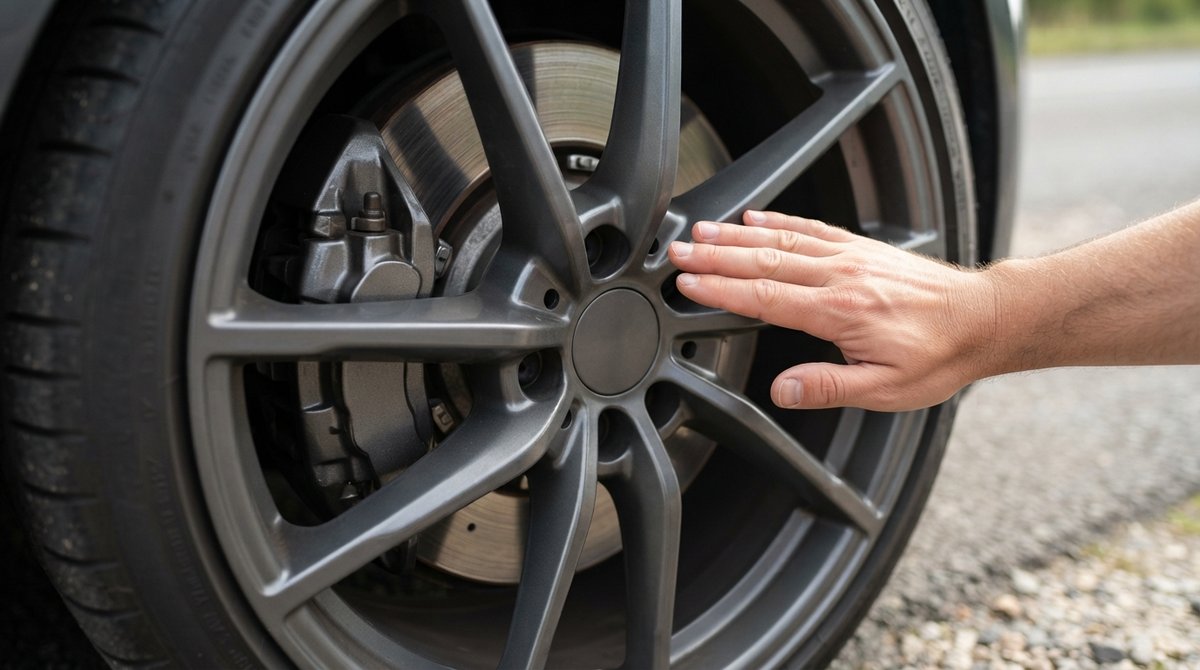
When a car pulls to one side when braking but drives straight the rest of the time, one front brake is gripping harder than the other. The car swings toward the side with more braking force, so you feel the steering wheel tug left or right as you slow down. Because this affects how the car behaves in an emergency stop, it’s a brake problem to fix soon, not a quirk to live with.
In this guide
| What you notice | Most likely cause | Urgency |
|---|---|---|
| Pull when braking, one wheel hot after a drive, burning smell | Sticking caliper or seized slide pins | High |
| Pull that started after a brake job | Dry slide pins, mismatched or contaminated pads | High |
| Pull away from one side, that wheel cool after a drive | Collapsed brake hose or blocked caliper on the other side | High |
| Pull plus a fluid leak near one wheel | Brake fluid on the pads | Stop driving |
| Pull plus a clunk over bumps | Worn control arm bushings or ball joints | Fix soon |
| Car also drifts when not braking | Alignment or tire pressure | Fix soon |
Car pulls to one side when braking: 6 causes
1. A sticking caliper or seized slide pins
Each caliper slides on two pins, and the piston has to move freely. When corrosion or dried-out grease makes a caliper stick, that side either grabs harder or releases slowly. A caliper that doesn’t release properly also drags while driving, so that wheel runs hot, you may smell burning, and fuel economy drops. This is the most common cause. It’s especially common on cars that sit for long periods or see a lot of road salt.
2. A collapsed brake hose
Rubber brake hoses can break down inside with age. A collapsed hose can stop fluid reaching one caliper fully, so that side brakes weakly and the car pulls the other way. It can also trap pressure, so that brake doesn’t release. Hoses are inexpensive and usually replaced in pairs, along with a brake fluid flush.
3. Contaminated or mismatched pads
Brake fluid, grease or oil on one pad reduces its grip, and the car pulls toward the other side. A leaking caliper seal, often visible as fluid leaking near the front wheel, is a common source. Fitting different pad brands or compounds on each side, or replacing pads on only one side, causes uneven braking too.
4. Uneven pad or rotor wear
If one side’s pads have worn much faster, or one rotor is badly scored, the braking force differs between sides. Uneven wear is usually a symptom of a sticking caliper, so check both. Our guide to brake pads vs rotors explains what to inspect.
5. Worn suspension parts
Braking pushes the weight forward onto the front suspension. A worn control arm bushing or ball joint lets one wheel shift backward or change angle under braking, steering the car to one side. You’ll often also hear a clunking noise over bumps.
6. Tires and alignment
A tire with much lower pressure, or very different tread, on one side can make the car pull more under braking. If the car also drifts when you’re not braking, see our guide to a car pulling to one side.
How to narrow it down
- Check all four tire pressures and look for uneven tread wear.
- After a 15-minute drive with normal braking, hold your hand near (not on) each front wheel. A much hotter wheel suggests a dragging caliper on that side.
- Look behind each front wheel for wet spots or fluid on the inside of the tire.
- Note which way it pulls. A pull to the left points to the left brake grabbing harder, or the right brake not working fully.
- Notice whether it started right after brake work. If so, go back to the shop first, since most brake jobs carry a warranty.
If the brake or ABS warning light is on, see our guides to the brake warning light and the ABS light. Look up any engine code in our OBD2 code lookup, and use the car symptom checker for other symptoms.
What a shop will check
A good brake inspection removes the wheels and checks that both calipers slide freely, both pistons retract, the hoses aren’t swollen or cracked, and the pad thickness is similar on both sides. Many shops also road-test the car and measure each wheel’s temperature after a few hard stops, which quickly shows which brake is doing more or less than its share.
How much does it cost to fix?
| Repair | Typical cost (parts and labor) |
|---|---|
| Cleaning and greasing slide pins | $50–$150 per axle |
| Brake hose (one side) | $150–$300 |
| Caliper (one side) | $150–$400 |
| Pads and rotors (one axle) | $250–$600 |
| Control arm or bushings (one side) | $200–$600 |
| Ball joint (one side) | $250–$500 |
| Wheel alignment | $80–$150 |
Is it safe to drive?
Not for long. A strong pull can make the car swerve in a hard stop, especially on wet or icy roads, and a dragging caliper can overheat and lose braking power. Stop driving if the pull is strong, the pedal feels soft, you see brake fluid, or you smell burning from one wheel. Brake components are sometimes recalled, so check the NHTSA recall lookup as well.
FAQ
Why does my car pull left when I brake?
Usually because the left front brake is grabbing harder than the right, from a sticking caliper or contaminated pads on one side, or the right brake isn’t working fully.
Can new brake pads cause pulling?
Yes, if the slide pins weren’t cleaned and greased, the pads don’t match, or the pads haven’t bedded in evenly. It should be checked rather than ignored.
Is a car pulling when braking an alignment problem?
Not usually. Alignment makes a car drift all the time. A pull only when braking points to the brakes or suspension.
Should both calipers be replaced at once?
Often, yes. Replacing calipers in pairs keeps braking even on both sides, especially on older cars where the other caliper is likely to stick soon.
Can low tire pressure cause pulling when braking?
It can make it worse. Check the pressures first, because it’s free and quick.