
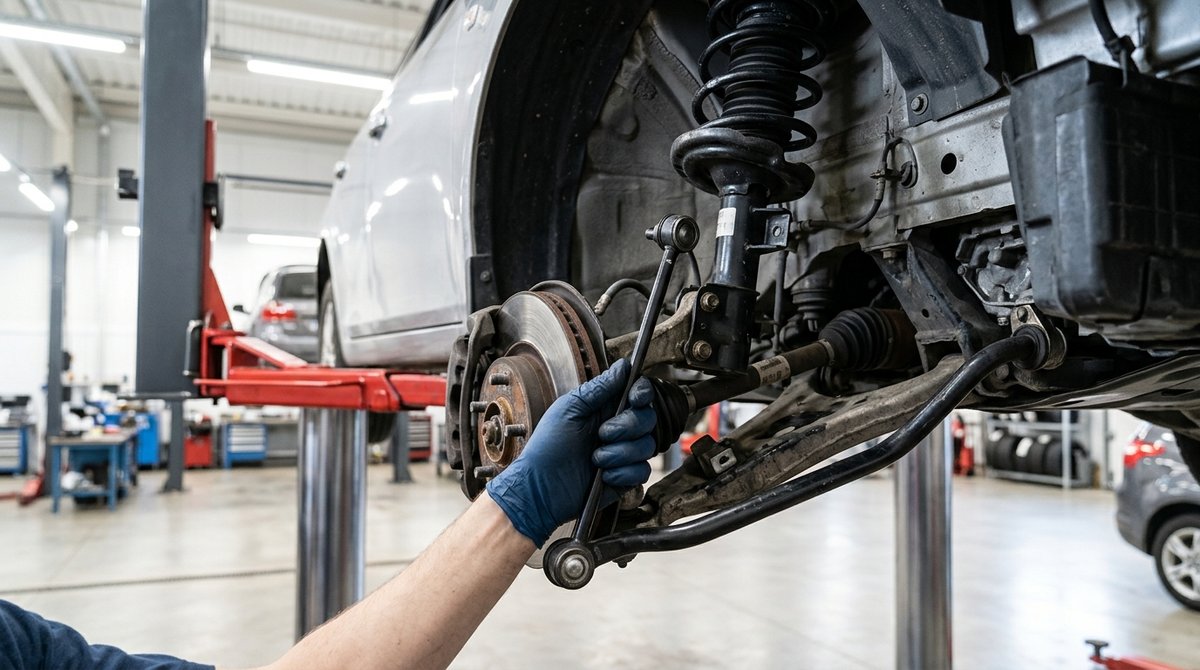
A clunking noise over bumps almost always means something in the suspension has worn loose and is knocking against a part it should be holding firmly. The good news is that the most common cause, a worn sway bar link, is one of the cheapest suspension repairs. The bad news is that several parts make a similar noise, so it’s worth narrowing it down before you buy anything.
In this guide
| What you notice | Most likely cause | Urgency |
|---|---|---|
| Light clunk or rattle over small bumps and rough roads | Worn sway bar links | Fix soon |
| Thud over larger bumps, sometimes with a creak | Worn sway bar bushings | Fix soon |
| Clunk from the top of the strut, often when turning the wheel too | Worn strut mount or bearing | Fix soon |
| Bouncy ride, knock on big bumps | Worn shocks or struts | Fix soon |
| Clunk plus loose or wandering steering | Worn ball joints or tie rods | High |
| Clunk when braking or pulling away over bumps | Worn control arm bushings | Fix soon |
| Metallic rattle from underneath | Loose heat shield or exhaust hanger | Low |
7 causes of a clunking noise over bumps
1. Worn sway bar links
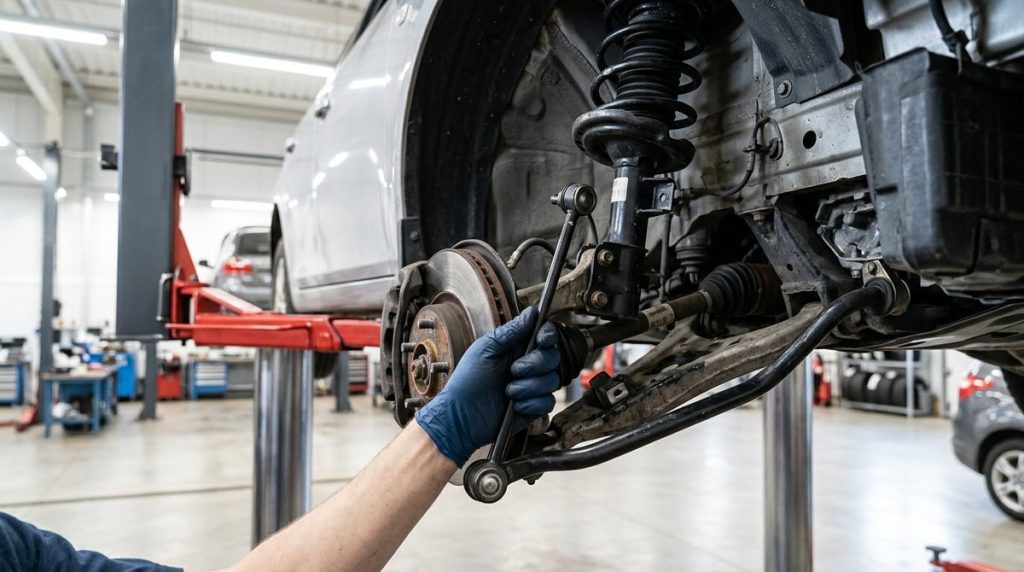
The sway bar (or anti-roll bar) reduces body lean in corners, and short links connect it to the suspension. Each end has a small ball joint that wears loose, causing a clunk or rattle over uneven roads, speed bumps, and potholes, often from one front corner. They’re inexpensive and often replaced in pairs. The noise is often loudest when one wheel hits a bump and the other doesn’t, because that twists the sway bar.
2. Worn sway bar bushings
Rubber bushings hold the sway bar to the car’s frame. When they wear or dry out, the bar can knock in its mounts, usually as a duller thud, sometimes with creaking on cold days.
3. A worn strut mount or bearing
The top of each front strut sits in a rubber mount, often with a bearing that lets it turn with the steering. A worn mount clunks over bumps, and a worn bearing may also clunk or bind when you turn the wheel at low speed.
4. Worn shocks or struts
Worn dampers let the suspension bottom out and the wheel bounce, which can cause knocks on bigger bumps. Push down hard on each corner of the car. If it bounces more than once or twice, the shocks or struts are tired. Oily residue on the body of a strut is another clue. Worn dampers also lengthen braking distances and make the car feel floaty on the highway, so they’re worth replacing even before the noise gets bad.
5. Worn ball joints
Ball joints connect the control arms to the steering knuckles. A worn one clunks over bumps and can make the steering feel vague. Because a failed ball joint can let a wheel separate from the suspension, this is the one to rule out first. Our guide to bad ball joint symptoms covers the signs.
6. Worn tie rods or control arm bushings
Loose tie rods cause knocks and play in the steering wheel. Worn control arm bushings let the arm shift, causing clunks over bumps and when you brake or pull away, and sometimes a car pulling to one side. A hard hit that bends a part can leave the steering wheel off center afterward.
7. Something loose underneath
A loose heat shield, a broken exhaust hanger, a loose spare tire, or even items in the trunk can rattle or clunk over bumps. Check the easy things first. A loose heat shield usually makes a tinny rattle rather than a deep clunk, and you can often hear it by tapping the exhaust with your hand when it’s cold.
How to pin down the clunk
- Empty the trunk and check that the spare tire and jack are secure.
- Note where the noise comes from (front, rear, left, right) and when: small bumps, big bumps, turning, braking, or pulling away.
- With the car parked, push down hard on each corner and listen.
- With the car safely raised and supported on stands, grab each sway bar link and try to move it. Any knock or play means it’s worn.
- A shop can check ball joints, tie rods and bushings with a pry bar, which takes a few minutes on a lift.
If the steering also feels vague or wanders at speed, see our guide to steering that feels loose. Suspension problems don’t usually set a code, but if a warning light is on, look it up in our OBD2 code lookup. The car symptom checker can help if you’ve noticed other symptoms.
How much does it cost to fix?
| Repair | Typical cost (parts and labor) |
|---|---|
| Sway bar links (pair) | $100–$300 |
| Sway bar bushings (pair) | $100–$250 |
| Strut mount (one side) | $150–$400 |
| Shocks or struts (pair) | $400–$1,000 |
| Ball joint (one side) | $250–$500 |
| Tie rod end (one side) | $100–$250 |
| Control arm with bushings (one side) | $200–$600 |
| Heat shield or exhaust hanger | $50–$150 |
| Wheel alignment after steering work | $80–$150 |
Is it safe to drive?
A clunk from a sway bar link or bushing is usually safe in the short term, though handling suffers. Worn ball joints, tie rods, and control arms are a safety issue, because they control where the wheel points. Get the car checked soon, and stop driving if the clunk gets suddenly louder, the steering feels loose, the car wanders, or a wheel looks tilted. Suspension parts are sometimes recalled, so check the NHTSA recall lookup too.
FAQ
What is the most common cause of a clunk over bumps?
Worn sway bar links. They’re cheap and quick to replace, so they’re a good place to start.
Can a bad strut make a clunking noise?
Yes. A worn strut mount or a strut that’s bottoming out can clunk over bumps.
Why does my car clunk over bumps at low speed?
Low-speed bumps like speed bumps and driveways load the suspension in ways that expose worn links, bushings, and mounts.
Can a clunk over bumps damage other parts?
Yes. A loose part lets others move more than they should, which wears bushings, tires, and joints faster. Fixing it early is usually cheaper.
Should I replace suspension parts in pairs?
Shocks, struts, and sway bar links are usually replaced in pairs so both sides behave the same.