
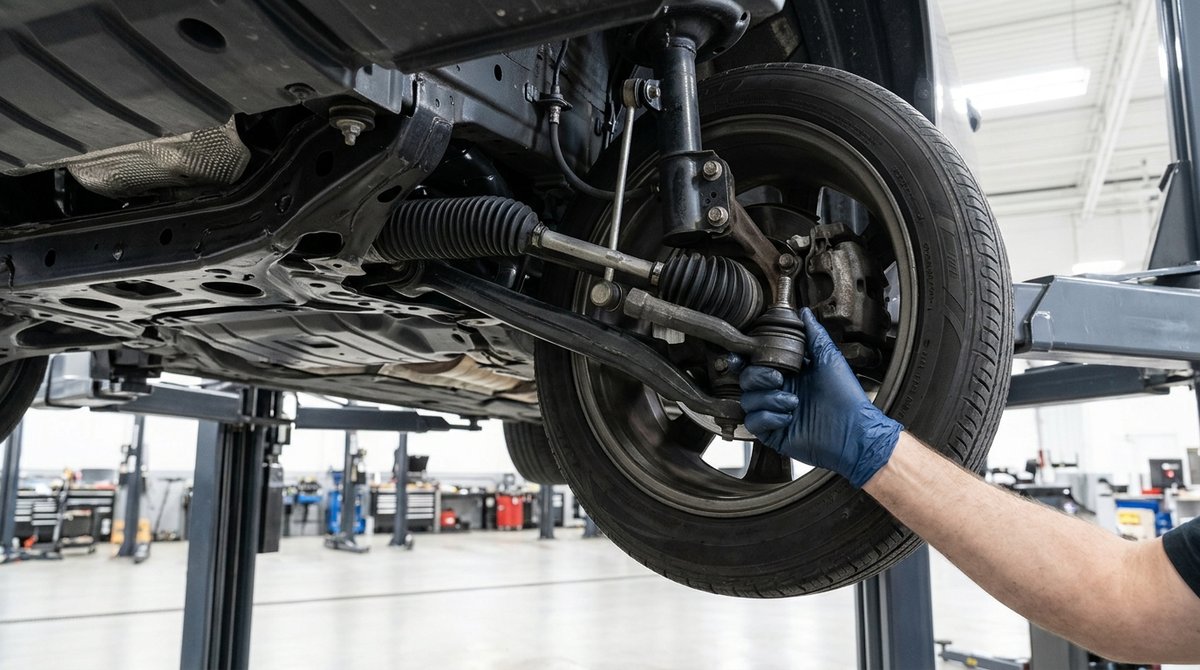
A little play in steering wheel movement is normal, but when you can turn the wheel noticeably before the car responds, something in the steering is worn. Drivers often describe it as a loose or dead spot in the center: the car wanders slightly on a straight road, and you keep making small corrections to hold your lane.
In this guide
| What you notice | Most likely cause | Urgency |
|---|---|---|
| Dead spot in the center, clunk over bumps | Worn outer or inner tie rod ends | High |
| Free play plus a knock you can feel through the wheel | Worn steering shaft joint or coupler | Medium to high |
| Gradual looseness, sometimes with a clunk turning slowly | Worn steering rack or loose rack mounts | Medium to high |
| Older truck or SUV with a steering box, slowly getting looser | Worn or out-of-adjustment steering gearbox | Medium |
| Looseness plus clunks and uneven tire wear | Worn ball joints or bushings | High |
| Light, vague center feel on a newer car, otherwise tight | Normal electric power steering feel | None |
How much play in steering wheel is normal?
Modern cars should have very little. With the engine running and the car parked, gently rock the wheel left and right. If it moves more than about an inch at the rim before the front wheels start to turn, it’s worth having the steering inspected. Many newer cars with electric power steering feel light in the center by design, but there should be no clunk and no free movement before the wheels respond.
What causes play in the steering wheel
1. Worn tie rod ends
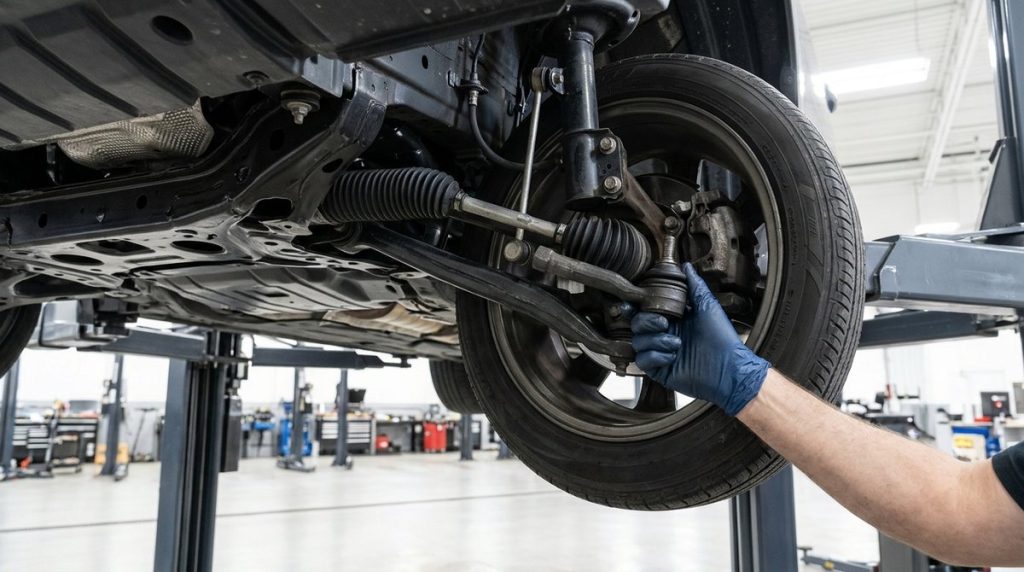
Tie rods connect the steering rack to each front wheel, with a small ball joint at each end. As those joints wear, they develop slack, which you feel as free play and a vague center. You may also hear a clunk over bumps and see the inner or outer edge of the front tires wearing faster. This is the most common cause. Inner tie rods sit inside rubber bellows at each end of the rack, so their wear is harder to see. A shop checks them by squeezing the bellows and feeling for movement while someone rocks the wheel.
2. A worn steering shaft joint
The shaft from the steering wheel down to the rack has universal joints or a rubber coupler. When they wear, you feel play and sometimes a knock or clunk through the wheel when turning at low speed.
3. A worn steering rack or loose mounts
The rack itself can wear internally, and the rubber bushings that hold it to the car can crack. Both let the rack shift before the wheels move. Sometimes a power steering leak shows up at the same time, which can make the steering wheel hard to turn. Noise is a different problem from play, and a power steering whine when cold usually comes from the pump and fluid.
4. A worn steering gearbox
Older trucks and SUVs often use a steering box instead of a rack. These wear gradually and can sometimes be adjusted, but an adjustment only helps if the box isn’t badly worn. A typical sign is a wheel you have to correct constantly on straight roads.
5. Worn ball joints, bushings, or wheel bearings
These parts aren’t in the steering itself, but they let the wheel move on its own. You’ll often hear clunks and feel the car drift. Our guide to bad ball joint symptoms covers the warning signs, and a loose wheel bearing can feel similar. Worn front-end parts often also cause a clunking noise over bumps.
How to check it yourself
- Park on level ground with the wheels straight. With the engine running, rock the steering wheel gently left and right and watch the front tires. Note how far the wheel moves before the tires respond.
- Have a helper rock the wheel while you look under the front with a flashlight, without getting under an unsupported car. Only a small rocking motion is needed, just enough to take up the slack. Look for any joint that moves before the part next to it does: tie rod ends, the rack, and the steering shaft.
- Check the tie rod rubber boots for tears and the front tires for uneven wear.
- Note whether the car also pulls to one side or the looseness is mostly at highway speed, which our guide to steering that feels loose covers.
Steering problems don’t usually set a code, but if a warning light is on, look it up in our OBD2 code lookup. The car symptom checker can help if you have other symptoms.
How much does it cost to fix?
| Repair | Typical cost (parts and labor) |
|---|---|
| Outer tie rod end (one side) | $100–$250 |
| Inner tie rod (one side) | $200–$400 |
| Wheel alignment (needed after tie rod work) | $80–$150 |
| Steering shaft or coupler | $200–$600 |
| Steering gearbox adjustment | $50–$150 |
| Ball joint (one side) | $250–$500 |
| Steering rack replacement | $800–$2,000 |
Is it safe to drive?
Treat it as a “get it checked soon” problem. A badly worn tie rod can separate, and when it does, you lose steering on that wheel. Stop driving and have the car towed if the play suddenly gets worse, you hear loud clunking when turning, the wheel shakes, or the car wanders across the lane. Steering parts are sometimes recalled, so check the NHTSA recall lookup before paying for a rack.
FAQ
Can low power steering fluid cause play in the steering wheel?
Usually not. Low fluid makes steering heavy or noisy rather than loose. Play almost always comes from worn mechanical parts.
Will an alignment fix a loose steering wheel?
No. An alignment sets the angles of the wheels but can’t remove wear. Worn parts need replacing first, then an alignment.
Why does my steering feel loose only in the center?
Wear in the tie rods, rack, or shaft joint shows up most where the steering changes direction, which is around the center.
Can worn tires make the steering feel loose?
They can add to it. Tires with uneven wear or the wrong pressure make the car feel vague and wander more, so check the pressures first. Real free play in the wheel, though, comes from worn parts.
How long do tie rods last?
Often 70,000 to 150,000 miles, but potholes, curb strikes, and torn boots wear them out much sooner. They’re usually checked at every alignment.