
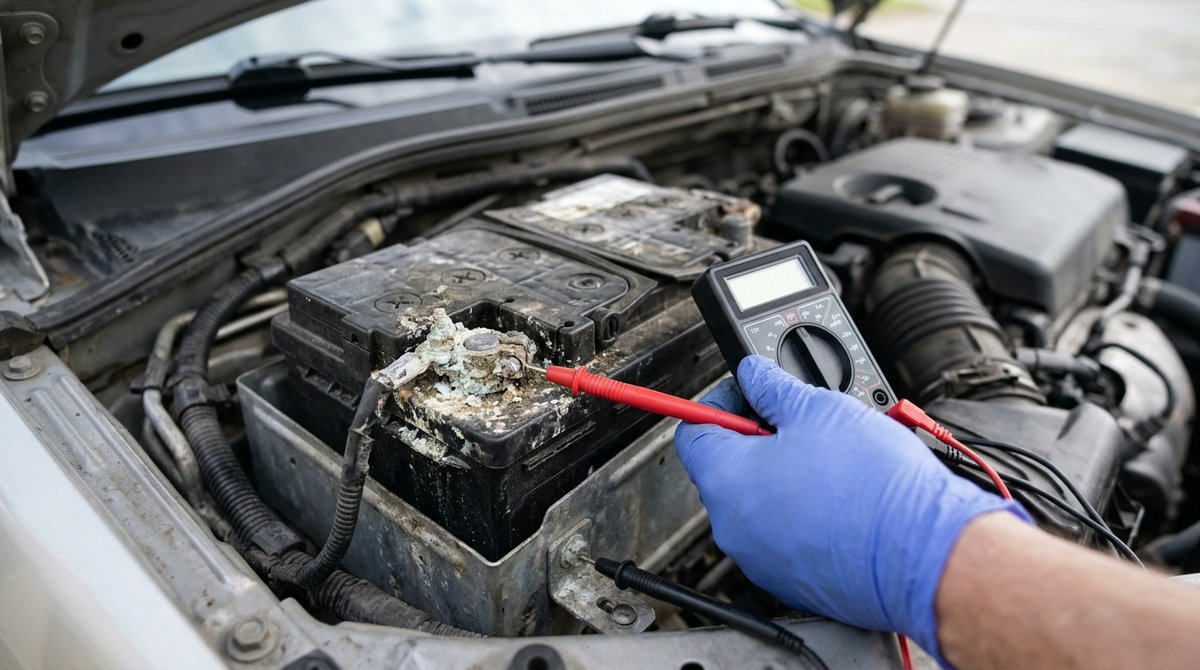
If your car battery smells like rotten eggs, the battery is venting gas, and that almost always means it’s being overcharged or failing inside. The smell is hydrogen sulfide, released when the acid inside a lead-acid battery gets too hot and starts to boil. The same process also releases hydrogen, which is flammable, so this is one smell you shouldn’t ignore.
In this guide
| What you notice | Most likely cause | Urgency |
|---|---|---|
| Sulfur smell near the battery after driving, battery warm | Overcharging from the alternator | High |
| Smell plus a swollen or bulging battery case | Overheated or failing battery | Stop using it |
| Smell plus wet, white or green crust on the terminals | Leaking acid or venting | Fix soon |
| Smell only while using a home charger | Charger overcharging the battery | Unplug it |
| Smell from the exhaust, worst when accelerating | Catalytic converter, not the battery | Fix soon |
Why a car battery smells like rotten eggs
A healthy battery is quiet and odorless. When it’s pushed too hard, the water in the acid breaks down and the battery vents gas through its caps or vents. The smell tells you the battery is overheating, and the cause is usually one of the following.
1. The alternator is overcharging
The alternator’s voltage regulator should hold the system at about 13.7 to 14.7 volts with the engine running. If the regulator fails, voltage can climb above 15 volts, and the battery is effectively boiled while you drive. You may also notice very bright headlights, bulbs burning out, or the battery light on while driving. If the warning appears mainly under throttle, see our guide to the battery light coming on when accelerating.
2. An internal short or failing cell
As batteries age, plates inside can short together. A shorted cell makes the battery draw too much charging current, so it heats up and vents even when the charging system is fine. These batteries often also struggle to start the car, which ties in with a car battery that keeps dying.
3. Overcharging with a home charger
An old or basic charger that doesn’t switch to maintenance mode can overcharge a battery left on it for days. If the smell only appears when the charger is connected, unplug it and use a smart charger that matches your battery type.
4. A cracked or leaking case
A cracked case or loose vent cap lets acid and gas escape. Look for wet patches on top of the battery, heavy white or greenish corrosion, or eaten-away metal on the battery tray.
5. Hot weather and an old battery
Heat speeds up everything inside a battery. An old battery in a hot engine bay is more likely to vent, especially on long drives in summer.
Is it the battery or the catalytic converter?
Both can smell like rotten eggs. A battery smell is strongest right by the battery with the hood open, often after a drive. A catalytic converter smell comes from the exhaust and is usually worst when you accelerate or right after hard driving. If yours fits the exhaust pattern, our guide to a car that smells like rotten eggs covers that side.
How to check it safely
- Turn the engine off and open the hood. Let the area air out for a few minutes, and don’t smoke or make sparks nearby.
- Without touching it, look for a swollen case, wet acid, or heavy corrosion.
- If the battery looks normal, measure the voltage at the terminals with a multimeter. With the engine off and rested, 12.4 to 12.7 volts is normal.
- Start the engine and measure again. Readings above about 15 volts point to overcharging.
- Many auto parts stores test the battery and charging system for free.
If the check engine light is also on, look up the code in our OBD2 code lookup, or run your symptoms through the car symptom checker.
How much does it cost to fix?
| Repair | Typical cost |
|---|---|
| Battery and charging system test | Free at many parts stores |
| Cleaning terminals and tray | $0–$30 |
| Standard battery (installed) | $120–$300 |
| AGM battery (installed) | $200–$400 |
| Alternator or voltage regulator | $400–$900 |
| Smart battery charger | $40–$100 |
How to clean battery corrosion safely
Light corrosion on the terminals is common and easy to clean, but only on a battery that isn’t swollen, hot, or leaking. With the engine off, disconnect the negative cable first, then the positive. Scrub the posts and clamps with a mix of baking soda and water and an old toothbrush, rinse with a little clean water, and dry everything. Reconnect positive first, then negative, and tighten both clamps. If heavy corrosion keeps coming back within weeks, the battery is likely venting, and the charging voltage should be tested.
Is it dangerous?
It can be. A battery that’s venting gas can build up hydrogen around it, and a spark can ignite it. Battery acid also burns skin and eyes. If the battery is hot, swollen, hissing, or smoking, turn off the engine, step away, and let it cool before anyone touches it. Don’t jump start it, charge it, or drive far on it. Wear eye protection and gloves if you have to handle a corroded battery, and replace any battery that has swollen. Electrical faults are sometimes covered by recalls, so check the NHTSA recall lookup as well.
FAQ
Can a car battery smell like rotten eggs without being bad?
Rarely. A sulfur smell means the battery was overheated or overcharged at least once. Even if it still works, have the battery and charging system tested.
Is it safe to drive with a battery that smells?
A short trip to a shop is usually fine if the battery isn’t swollen or hot. Turn off unneeded electrical loads, and stop if the smell gets stronger.
Do AGM batteries smell when they fail?
Less often, because they’re sealed. They can still vent through safety valves if they’re badly overcharged, so the same checks apply.
How long does a car battery last?
Typically three to five years, and less in hot climates. A battery near that age that starts to smell, swell, or struggle in the morning is usually due for replacement.