
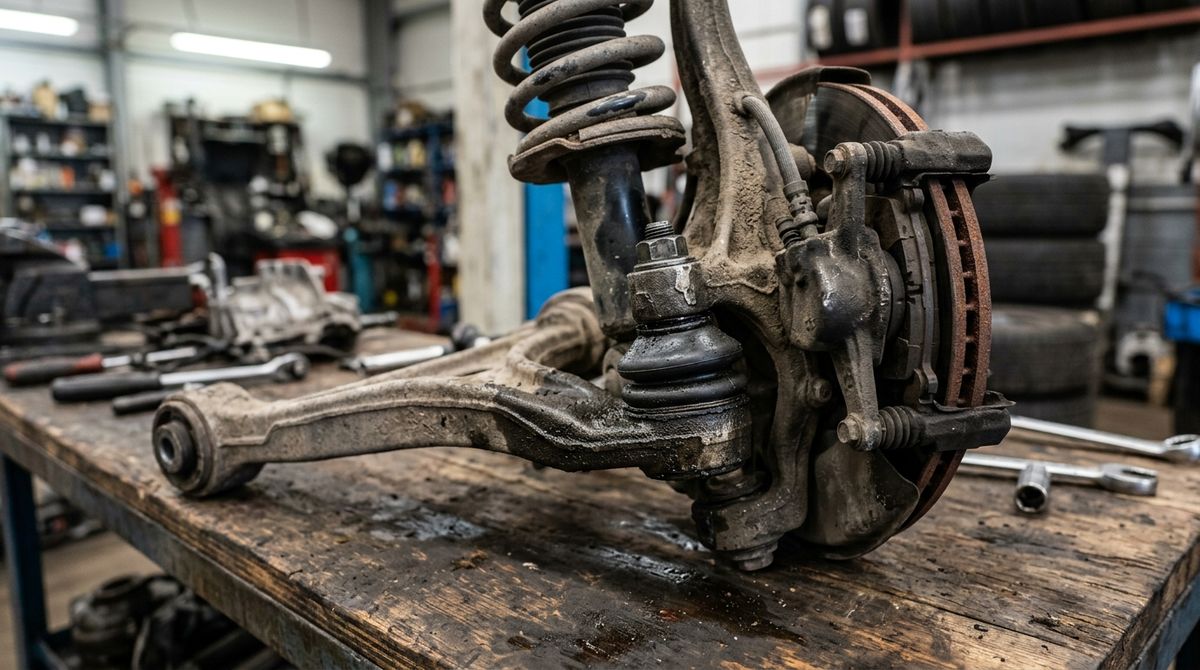
Bad ball joint symptoms usually start quietly: a faint clunk over a speed bump, a creak when you turn into a driveway, or steering that feels a little vaguer than it used to. Because the signs build slowly, they’re easy to ignore. That’s a mistake with this part in particular, because a ball joint that fails completely can let a front wheel collapse.
In this guide
Quick answer
| Sign | What it usually means |
|---|---|
| Clunk or knock over bumps, especially at low speed | Worn ball joint or sway bar link |
| Creak or squeak when turning or going over bumps | Dry ball joint, often with a torn boot |
| Steering feels loose or the car wanders | Worn ball joints or tie rod ends |
| Inner or outer edge of a front tire wearing fast | Play in the ball joints throwing off alignment |
| Clicking that speeds up as you turn | Usually a CV joint, not a ball joint |
| Grease on the inside of the wheel | Torn ball joint boot |
What a ball joint does
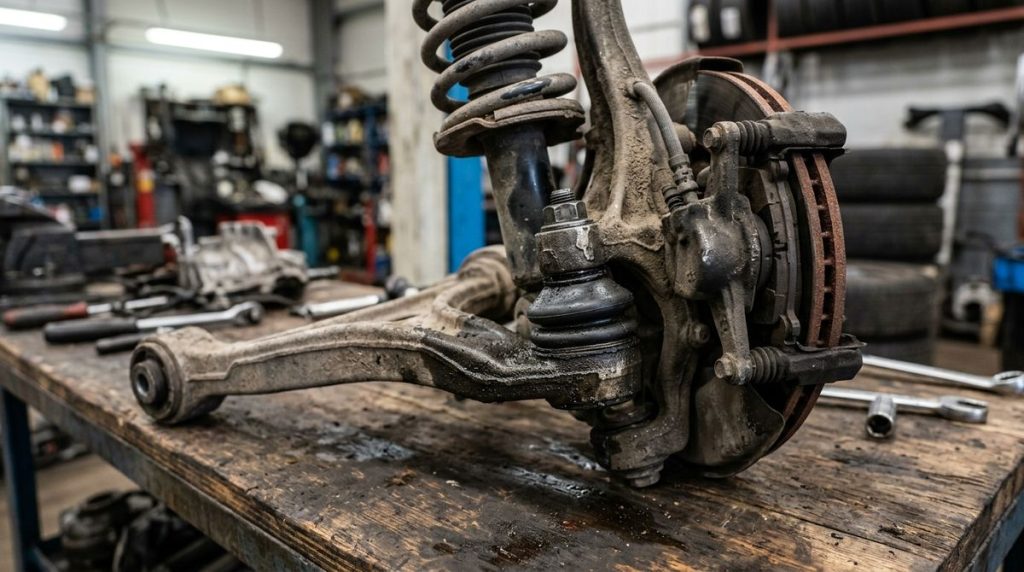
Ball joints connect your car’s steering knuckle, the part the wheel bolts to, to the suspension’s control arms. They work like the ball-and-socket joint in your hip, letting the wheel move up and down over bumps and pivot left and right when you steer. Over time, the ball wears and the socket loosens, especially once the rubber boot tears and lets grit and water in.
Bad ball joint symptoms to watch for
Clunking or knocking over bumps
The most common sign. A loose joint lets the suspension shift and knock as the wheel moves up and down. It’s often loudest over speed bumps and potholes at low speed.
Creaking or squeaking
A joint that has lost its grease creaks like an old door hinge when you turn or go over bumps. It’s often worse in cold weather.
Loose or wandering steering
Play in the ball joints lets the wheel move slightly on its own, so the car drifts and needs constant small corrections. Our guide to steering feels loose covers this in more detail.
Uneven tire wear
A worn joint lets the wheel tilt out of alignment, which shows up as rapid wear on the inner or outer edge of a front tire.
Pulling or vibration
Worn joints can make the car pull to one side or add a vibration through the steering wheel. See car pulling to one side and steering wheel shakes at high speed.
Ball joint, CV joint, tie rod, or sway bar link?
Several front-end parts make similar noises, so it helps to know the differences. A rhythmic clicking that gets faster as you turn sharply is usually a CV joint; see clicking noise when turning. A light rattle or clunk over small bumps is often a sway bar link, a cheaper fix. Play you can feel in the steering wheel points more toward tie rod ends. A heavier clunk over bigger bumps, along with wandering, points to ball joints. Worn tie rods cause similar clunks, and they’re the most common reason for play in steering wheel. Ball joints aren’t the only source of knocks, so see the other causes of a clunking noise over bumps.
How a mechanic checks ball joints
With the front of the car raised and safely supported, a mechanic grabs the tire at the top and bottom and rocks it in and out, watching for movement at the joint. They may also use a pry bar to check for play. Some ball joints have a built-in wear indicator: a small collar around the grease fitting that sinks into the joint as it wears. If you check yourself, always use jack stands, never just a jack.
How long do ball joints last?
There’s no fixed lifespan. Many ball joints last well over 100,000 miles, while others wear out much sooner on rough roads, on heavier vehicles, or on trucks with lifted suspensions and bigger tires. A torn rubber boot speeds up wear dramatically, because grit and water get into the joint. Some ball joints have grease fittings and last longer if they’re greased at each oil change. Having the front suspension checked whenever the tires are rotated or the car is on a lift is the easiest way to catch wear early.
What happens if a ball joint fails completely?
When a worn ball joint finally separates, the steering knuckle is no longer held in place properly. The wheel can tilt sharply or fold under the car, and steering on that side is lost. At low speed it usually means a scary stop and a tow; at highway speed it can cause a crash. That’s why mechanics treat noticeable ball joint play as a safety repair rather than something to monitor.
Bad ball joint symptoms: repair costs
| Repair | Typical cost |
|---|---|
| Sway bar link (per side) | $100–$250 |
| Outer tie rod end (per side) | $150–$300 |
| Ball joint (per side) | $200–$450 |
| Lower control arm with built-in ball joint (per side) | $250–$600 |
| Wheel alignment (needed after the repair) | $80–$150 |
Many modern cars have the ball joint built into the control arm, so the whole arm is replaced. Ball joints are often replaced in pairs so both sides wear evenly, and an alignment afterward protects your tires. It’s also worth entering your VIN in the NHTSA recall lookup, since suspension parts are sometimes covered by recalls.
Is it safe to drive with a bad ball joint?
Treat it as urgent. A ball joint that separates completely can let the wheel fold under the car, causing a sudden loss of steering and control, which is far more dangerous at speed. If you’ve noticed clunking, wandering, or creaking, have it inspected within days, not weeks. If the noise gets suddenly worse, the steering feels very loose, or the car pulls hard, stop driving and have it towed.
Suspension wear doesn’t set a check engine code, but if a warning light is on for another reason, our OBD2 code lookup can decode it. For other noises and symptoms, try the free car symptom checker.