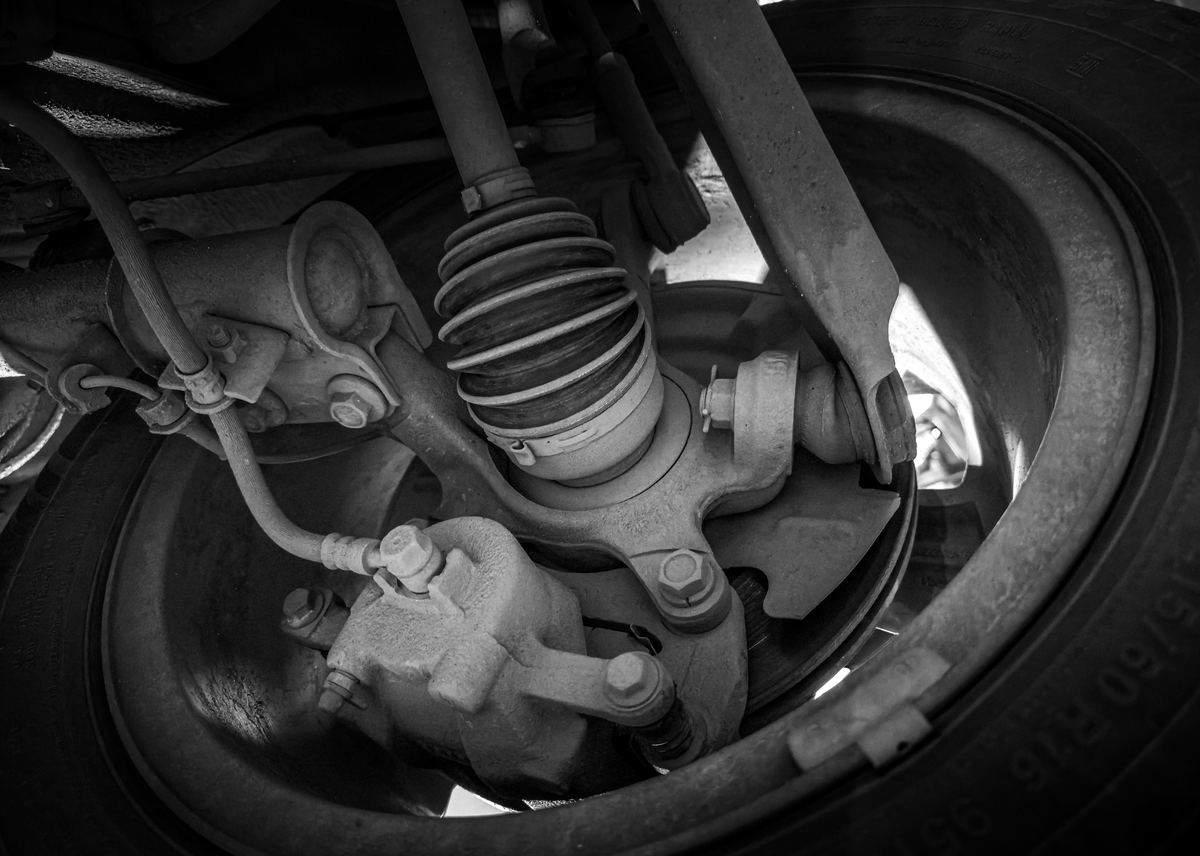
A clicking noise when turning is most often caused by a worn outer CV joint, especially if the clicking happens during sharp turns while accelerating. Other common causes include worn strut mounts, bad ball joints or tie rod ends, worn sway bar links, loose brake parts, or a worn clock spring inside the steering column.
The key to finding the cause is noticing when the clicking happens. Below, we’ll break down each cause, how to test for it, and what repairs typically cost.
When Does the Clicking Happen?
- Sharp turns while accelerating (like in a parking lot): almost always a CV joint.
- Turning the steering wheel at low speed or while parked: often strut mounts or suspension parts.
- Turning and going over bumps: usually sway bar links, ball joints, or tie rod ends.
- Inside the car, from the steering column: possibly the clock spring.
- Clicking that speeds up with the car, even going straight: likely something stuck in a tire, a loose wheel cover, or loose brake parts.
6 Causes of a Clicking Noise When Turning
1. Worn Outer CV Joint (Most Common)
Front-wheel-drive and all-wheel-drive cars use constant velocity (CV) joints to send power to the wheels while they turn. Each joint is protected by a rubber CV boot filled with grease. If the boot tears, the grease escapes, dirt gets in, and the joint wears out.
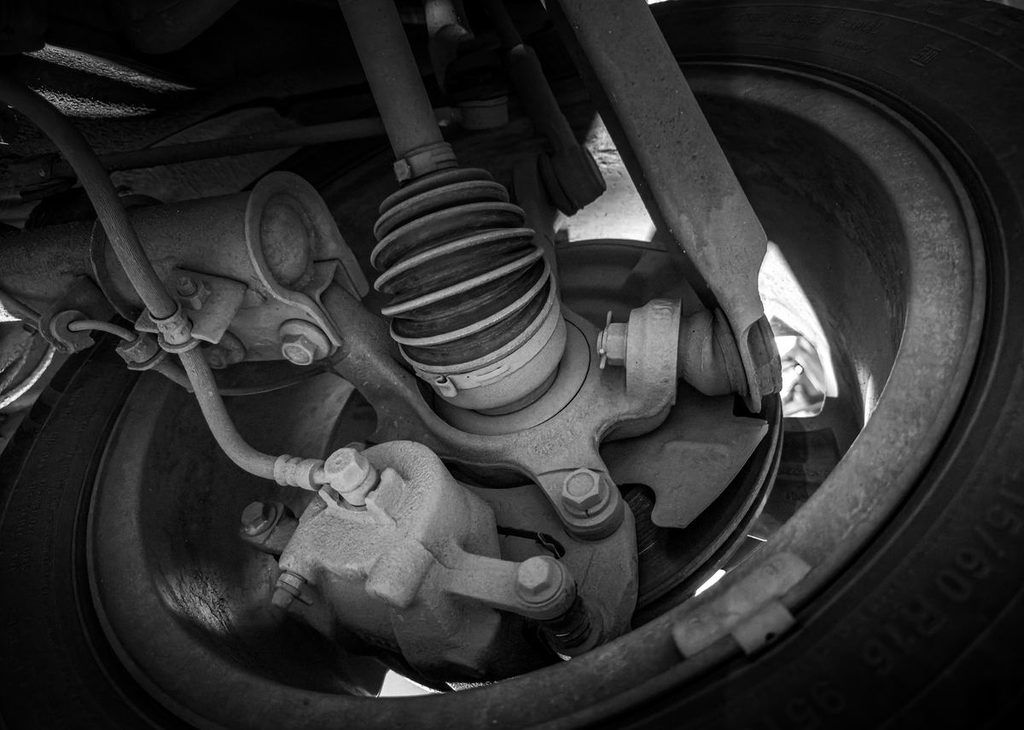
Signs: rhythmic clicking or popping during sharp turns, louder when accelerating; grease splattered on the inside of the wheel or suspension parts.
Fix: if caught early, replace the torn boot. Once the joint clicks, replacing the whole CV axle is usually the simplest and most cost-effective fix.
2. Worn Strut Mounts or Strut Bearings
On many cars, the front struts sit on a mount with a bearing that lets them rotate when you steer. When that bearing wears out, it can click, pop, or creak as you turn the wheel.
Signs: noise when turning the steering wheel at low speed or while parked, sometimes a stiff or “notchy” steering feel.
Fix: replace the strut mounts (often done together with the struts), followed by a wheel alignment.
3. Worn Ball Joints or Tie Rod Ends
Ball joints connect your wheels to the suspension, and tie rod ends connect them to the steering. When they wear, they develop play that can click or clunk during turns.
Signs: clunking over bumps, loose or wandering steering, uneven tire wear.
Fix: replace the worn parts, then get an alignment. Don’t delay this one, because a failed ball joint can cause loss of control.
4. Worn Sway Bar Links
Sway bar links connect the anti-roll bar to the suspension. Their small joints wear out and create clicking or knocking, especially when turning over uneven surfaces.
Signs: clicking or rattling over bumps and during turns, usually from the front.
Fix: replace the links. This is one of the cheaper suspension repairs and a common DIY job.
5. Loose Brake Parts, Wheel Covers, or Debris
Not every clicking noise is serious. Loose caliper bolts, missing brake pad clips, a loose hubcap, or a stone stuck in your tire tread can all click, often in rhythm with wheel speed.
Signs: clicking that changes with vehicle speed, sometimes even when driving straight.
Fix: remove the debris, secure the wheel cover, or have the brakes checked and loose parts tightened.
6. Worn Clock Spring
The clock spring is a coiled ribbon inside the steering column that keeps the airbag, horn, and steering wheel buttons connected while you turn. When it wears, it can click or rub.
Signs: clicking or scraping from inside the car when turning the wheel, sometimes with an airbag warning light or a horn that stops working.
Fix: replace the clock spring. Because it involves the airbag, this is a job for a professional.
Is It Safe to Drive?
- CV joint clicking: usually safe for short trips, but get it fixed soon. A failed CV joint can leave you stranded.
- Ball joints or tie rod ends: get them inspected right away. Failure can affect steering control.
- Clicking plus a warning light, loose steering, or grinding: stop driving and have the car checked.
It’s also worth checking for open safety recalls on your vehicle at NHTSA.gov/recalls, since steering and suspension parts are sometimes covered.
DIY Checks You Can Do
- Parking lot test: in an empty lot, turn the wheel fully to one side and drive slowly in a circle, then repeat the other way. Consistent clicking that gets louder with acceleration points to a CV joint.
- Inspect the CV boots: look behind each front wheel for torn rubber boots or grease splatter.
- Stationary steering test: with the car parked and the engine running, turn the wheel side to side while someone listens near the front wheels. Clicking from the top of the wheel well suggests strut mounts.
- Bounce test: push down hard on each corner of the car and listen for clicks or clunks from sway bar links or mounts.
- Check the tires and wheels: look for stones in the tread and make sure wheel covers and lug nuts are tight.
Typical Repair Costs
Rough US shop estimates; prices vary by vehicle and location:
- CV boot replacement: about $150–$400 per side
- CV axle replacement: about $250–$700 per side
- Strut mounts: about $200–$500 per side, plus alignment
- Sway bar links: about $100–$250 each
- Ball joint or tie rod end: about $150–$400 each, plus alignment
- Clock spring: about $150–$500
How to Prevent It
- Ask your mechanic to check the CV boots at every oil change. A $150 boot job can save a $500 axle.
- Avoid hitting curbs and potholes hard.
- Get an alignment check once a year or after any hard impact.
If you’re also feeling vibration when you stop, see our guide on why your car shakes when braking at high speed.
FAQ
Why does my car make a clicking noise only when turning at low speed?
Low-speed turns, like parking, put the most angle on CV joints and the most load on strut mounts, so worn parts are easiest to hear then.
How long can I drive with a clicking CV joint?
It varies. Some last weeks, others fail sooner. Because a failed joint means the car can’t move, it’s best to replace it as soon as you can.
Is a clicking noise when turning expensive to fix?
Often not. Sway bar links and CV boots are relatively cheap. CV axles and strut mounts cost more but are still common, routine repairs.
Can low power steering fluid cause clicking?
Usually not. Low power steering fluid tends to cause whining or groaning, not clicking.
Safety note: Steering and suspension problems can affect control of your vehicle. If you’re unsure, have a certified mechanic inspect your car.