
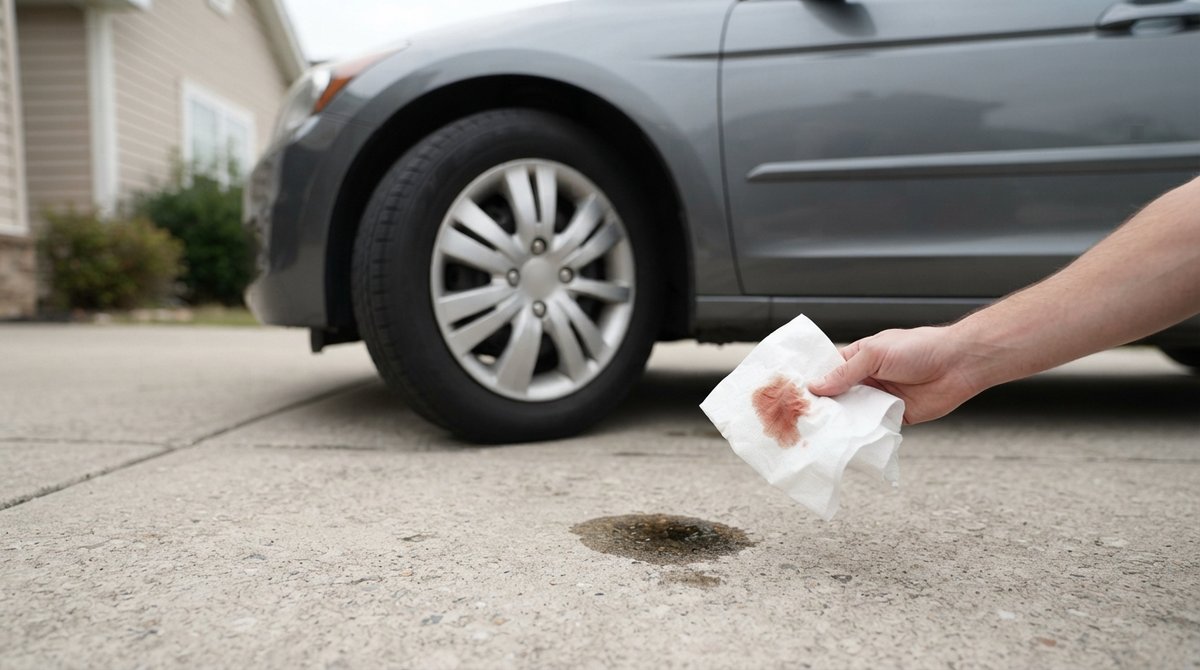
Finding fluid leaking near front wheel areas is more worrying than a drip in the middle of the car, because several important systems meet there: the brakes, the steering, the axle, and sometimes the cooling system. The good news is that each fluid looks, smells, and feels different, so a few minutes with a paper towel and a flashlight usually tells you which one you’re dealing with.
In this guide
| What you see | Where exactly | Most likely fluid | Urgency |
|---|---|---|---|
| Clear to yellow-brown, slick, inside of tire or rim wet | At the brake caliper or hose | Brake fluid | Stop driving |
| Thick, dark grease sprayed around the inside of the wheel | Inner side, near the axle | CV joint grease (torn boot) | Fix soon |
| Red or amber, slick | Near the inner end of the steering rack | Power steering fluid | Fix soon |
| Green, orange, pink or blue, sweet smell | Front corner, near the radiator | Coolant | Fix soon |
| Blue, thin, smells like glass cleaner | Front corner, behind the bumper | Washer fluid | Low |
| Oily film on the shock body | On the strut or shock absorber | Shock or strut oil | Fix soon |
| Clear water, no smell, passenger side | Under the front passenger footwell area | AC condensation | Normal |
Fluid leaking near front wheel: 7 possible sources
1. Brake fluid
This is the one that matters most. Brake fluid is clear to light brown, slick between your fingers, and has a faint oily smell. A leak at a caliper piston seal, a bleeder screw, or a rubber brake hose wets the inside of the wheel and tire. Check the brake fluid reservoir: if the level is dropping, or the brake warning light is on, don’t drive the car. Brake fluid also strips paint, so wipe it off the bodywork quickly.
2. CV joint grease
Front-wheel-drive cars have a rubber boot over each CV joint. When a boot tears, the spinning axle flings thick, dark grease around the inside of the wheel, the suspension, and the brake parts. It isn’t a fluid drip so much as a messy spray. Left alone, dirt gets in and the joint starts clicking when turning. Replacing a boot early is much cheaper than replacing the axle.
3. Power steering fluid
On cars with hydraulic power steering, the rack’s inner seals can leak into the rubber bellows at each end, and fluid then drips near the front wheels. It’s usually red or amber. A low level can make the steering wheel hard to turn or noisy, especially on cold mornings.
4. Coolant
The radiator, its hoses, and sometimes the coolant reservoir sit near the front corners. Coolant is brightly colored and smells sweet. Keep an eye on the temperature gauge and the reservoir, and clean up spills, because coolant is toxic to pets.
5. Washer fluid
On many cars the washer reservoir sits behind the front bumper, near one wheel. A cracked reservoir or loose hose drips thin blue fluid, and the washers may stop spraying. See our guide to a windshield washer not working.
6. Shock or strut oil
A worn strut can leak its oil down the outside of its body. You’ll see an oily, dirty film on the strut itself, and the car may bounce more over bumps. A light misting of oil can be normal on some struts, but drips or a wet, grimy body mean it’s leaking.
7. AC condensation
Clear, odorless water under the passenger side is usually the AC drain, which is normal. Our guide to a car leaking water underneath explains how to tell it apart from other leaks.
How to identify the leak
- Park on a clean surface and slide white paper or cardboard under the front of the car overnight.
- Check the color, then rub a drop between your fingers and smell it.
- With a flashlight, look at the inside of the wheel: the brake caliper and hose, the CV boot, the steering rack bellows, and the strut.
- Open the hood and check the brake, power steering, coolant, and washer fluid levels against their marks.
- Note whether the leak gets worse after driving, after turning, or after braking.
If a warning light is on, look up any code in our OBD2 code lookup, and use the car symptom checker if you’ve noticed other symptoms.
How much does it cost to fix?
| Repair | Typical cost (parts and labor) |
|---|---|
| Brake hose | $150–$300 |
| Brake caliper (one side) | $150–$400 |
| CV boot replacement | $150–$350 |
| CV axle replacement | $200–$700 |
| Power steering hose | $150–$400 |
| Steering rack | $800–$2,000 |
| Radiator hose | $100–$300 |
| Washer reservoir | $50–$300 |
| Strut (one side) | $200–$500 |
Is it safe to drive?
Not if it’s brake fluid. A brake fluid leak can make the brake pedal go to the floor, so have the car towed or inspected where it is. CV grease, power steering fluid, coolant, and strut oil are usually safe for short trips, but get them fixed soon, and watch the temperature gauge with a coolant leak. Washer fluid and AC water aren’t safety issues. Leaking brake and steering parts are sometimes recalled, so check the NHTSA recall lookup.
FAQ
Why is there a wet spot under only one front wheel?
Because the source is on that corner: usually a brake caliper or hose, a torn CV boot, a steering rack seal, or a washer reservoir on that side.
How can I tell brake fluid from power steering fluid?
Brake fluid is clear to light brown and thin. Power steering fluid is usually red or amber. Check which reservoir is dropping to be sure.
Is grease on the inside of my wheel a problem?
Usually it means a torn CV boot. It isn’t urgent today, but replace the boot soon before the joint wears out.
Can a leak near the front wheel be engine oil?
Yes. Oil from a leaking gasket can run along the subframe and drip near a wheel. It’s brown or black and greasy, and the dipstick level drops over time.
Can a leaking shock be dangerous?
It reduces grip and stability, especially in emergency maneuvers and on rough roads, so plan to replace it, ideally in pairs.