
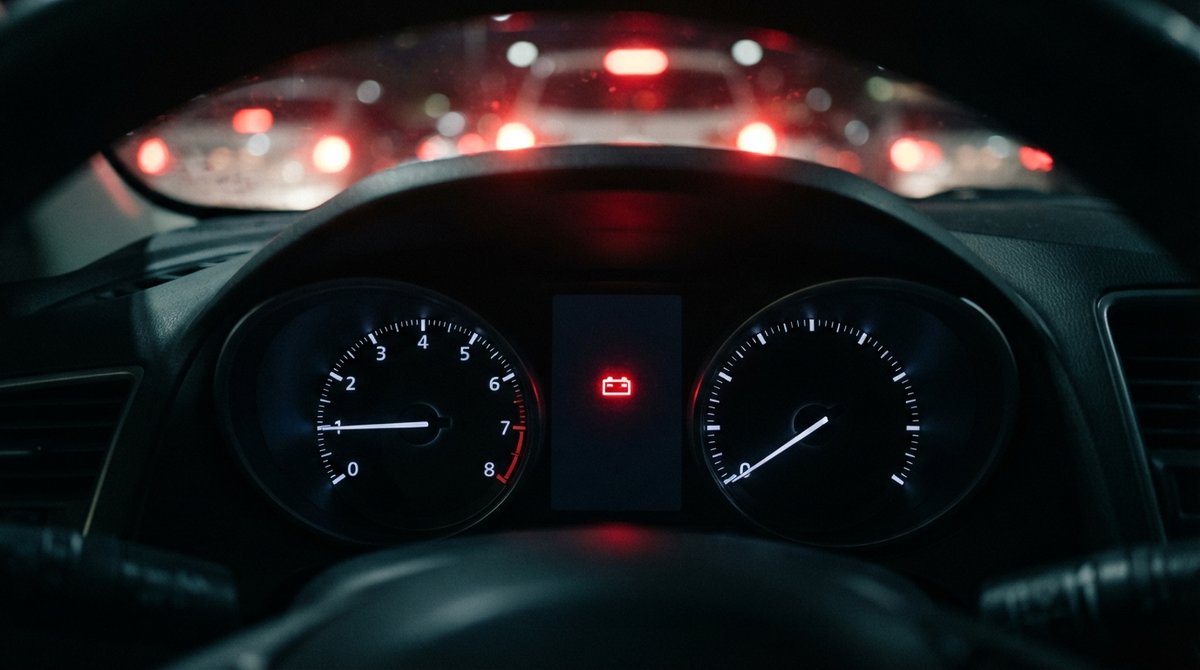
A battery light on at idle that goes out the moment you press the gas is a classic sign that the charging system can’t keep up at low engine speed. The alternator’s output rises with RPM, so a weak alternator, a low idle, or a poor connection can leave the system short of voltage at a stoplight, then recover as soon as the engine speeds up. It’s often an early warning, so it’s worth checking before the battery starts going flat.
In this guide
| What you notice | Most likely cause | First check |
|---|---|---|
| Light on at idle, off above about 1,200 RPM | Alternator with weak low-speed output | Test voltage at idle and at 2,000 RPM |
| Light on at idle mainly with headlights, blower and rear defroster on | Electrical load higher than idle output | Turn loads off and watch the light |
| Idle speed lower than normal, engine feels rough | Low idle speed | Watch the tachometer at a stop |
| Light flickers at idle and over bumps | Loose or corroded connection | Check terminals and the alternator cable |
| Light at idle plus a squeal on startup | Worn belt or weak tensioner | Inspect the belt |
| Light at idle and a battery that keeps going flat | Alternator failing, or an old battery | Test both at a parts store |
Battery light on at idle: 6 common causes
The alternator is spun by the serpentine belt, so at idle it turns at its slowest. A healthy alternator still produces enough current at idle to run the car and charge the battery. When something in the charging system is weak, idle is the first place it shows.
1. An alternator with weak low-speed output
Worn brushes, a failing diode, or a tired voltage regulator reduce the alternator’s output. At higher RPM it can still make enough voltage to keep the light off, but at idle it can’t. This is the most common cause, and it usually gets worse over weeks or months. A whining sound from the alternator or dimming headlights at stops are extra clues.
2. Heavy electrical load at idle
Winter makes this worse. Headlights, the heater blower on high, the rear defroster, heated seats, and wipers can draw more current than a slightly weak alternator produces at idle. If the light goes out when you switch off a few loads, the alternator is marginal rather than dead.
3. A low idle speed
If the engine idles lower than normal because of a dirty throttle body, an idle control fault, or a vacuum leak, the alternator turns even slower. The engine may also feel rough at stops, which overlaps with a car that shakes when idling.
4. A loose or corroded connection
Corroded battery terminals, a loose output cable on the back of the alternator, or a poor engine ground can drop voltage when output is already low. Cleaning and tightening the connections is cheap and sometimes fixes the light entirely.
5. A worn belt or tensioner
A glazed belt or a weak tensioner can let the alternator pulley slip, especially right after a cold start. Belt slip usually shows up more under load, which is covered in our guide to the battery light coming on when accelerating, but a badly worn belt can cause it at idle too.
6. A failing battery
A battery with a weak cell can pull more charging current than normal, which drags the voltage down at idle. If the battery is more than four or five years old, test it alongside the alternator.
How to test it
- With the engine off, measure the battery voltage. About 12.4 to 12.7 volts is normal.
- Start the engine, let it idle, and turn on the headlights, the blower on high, and the rear defroster. The voltage should stay above about 13.2 volts.
- Raise the engine to about 2,000 RPM. A healthy system reads between 13.7 and 14.7 volts.
- If voltage is low at idle but normal at 2,000 RPM, the alternator is weak at low speed or the idle is too low.
- Many auto parts stores test the battery and alternator for free.
If the light stays on all the time instead, see our guide to the battery light on while driving. If a check engine light comes on too, look up the code in our OBD2 code lookup, and the car symptom checker can help with other symptoms.
How much does it cost to fix?
| Repair | Typical cost (parts and labor) |
|---|---|
| Charging system test | Free at many parts stores |
| Cleaning and tightening connections | $0–$50 |
| Throttle body cleaning (for low idle) | $10 DIY, $50–$150 at a shop |
| Serpentine belt | $100–$250 |
| Battery replacement | $120–$300 |
| Alternator replacement | $400–$900 |
Is it safe to drive?
Usually, for now. The alternator still charges at normal driving speeds, so the battery recovers on the open road. In heavy stop-and-go traffic, though, the car can run down the battery, and in winter that can leave you with a car that clicks but won’t start. Keep unnecessary electrical loads off at stops and get the charging system tested soon. If the light stays on at all speeds, or the headlights dim badly, head straight to a shop. Charging-system recalls do happen, so check the NHTSA recall lookup too.
FAQ
Why does my battery light go off when I accelerate?
Because the alternator spins faster and produces more voltage at higher RPM. A weak alternator can just about keep up above idle, but not at idle.
Is it the battery or the alternator?
The light points to the charging system, so the alternator is the usual suspect. Test both, because a weak battery can make the problem worse.
Can cold weather make the battery light come on at idle?
Yes. Winter loads like the heater blower, defroster, and headlights all draw current at the same time, which exposes a weak alternator at idle.
How long can I drive with the battery light on at idle?
Normal driving is usually fine for a short time, but don’t wait weeks. Low-speed charging problems tend to get worse, and the next stage is a flat battery.