
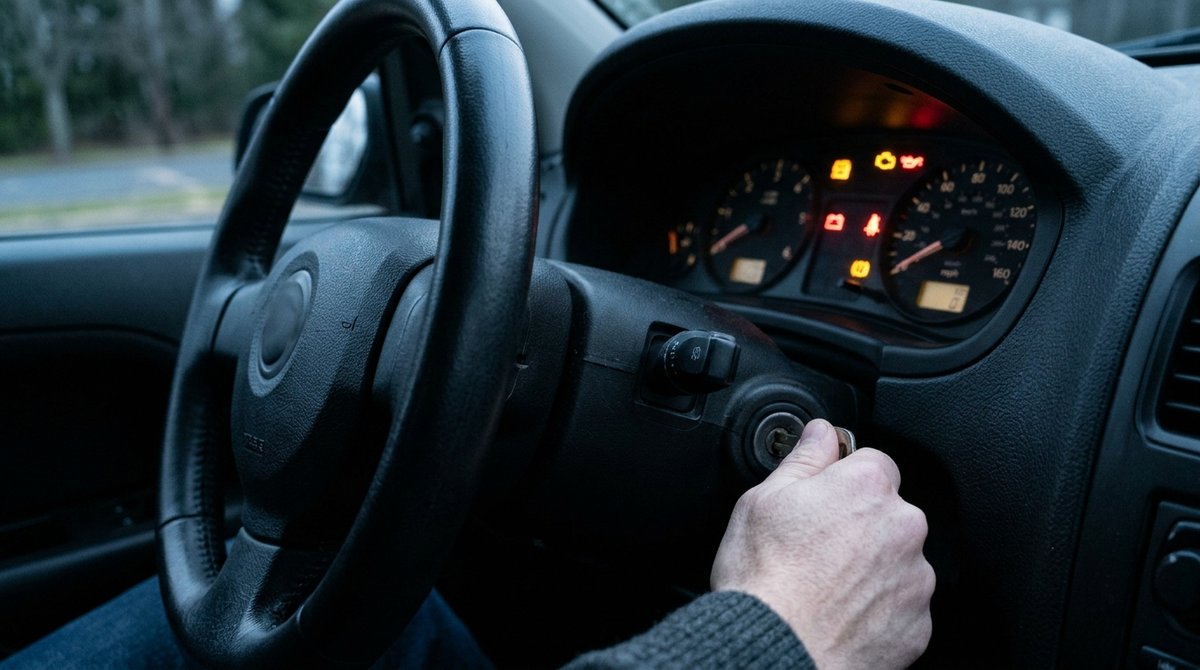
When your car clicks but won’t start, the sound itself is the best clue you have. A fast, machine-gun rattle and a single solid click come from the same part of the car, but they point to very different problems, and one of them is usually fixed with a jump start.
In this guide
| What you hear and see | Most likely cause | First thing to try |
|---|---|---|
| Rapid clicking, dash lights dim or flicker | Weak or dead battery | Jump start or charge the battery |
| Rapid clicking, battery tested good | Loose or corroded battery terminals | Clean and tighten the terminals |
| One loud click, lights stay bright | Failing starter motor or solenoid | Have the starter tested |
| One click, lights go out | Bad connection or main cable | Check terminals and ground strap |
| Clicking from the dash or fuse box only | Starter relay or immobilizer | Try the spare key, check the relay |
| No click at all, lights work | Neutral safety switch or ignition switch | Try starting in Neutral |
Why your car clicks but won’t start
The starter has a solenoid, an electric switch that does two jobs. It pushes the starter gear into the engine’s flywheel and connects the heavy battery current to the starter motor. The click you hear is that solenoid moving. What happens after the click tells you where the problem is.
Rapid clicking: weak battery
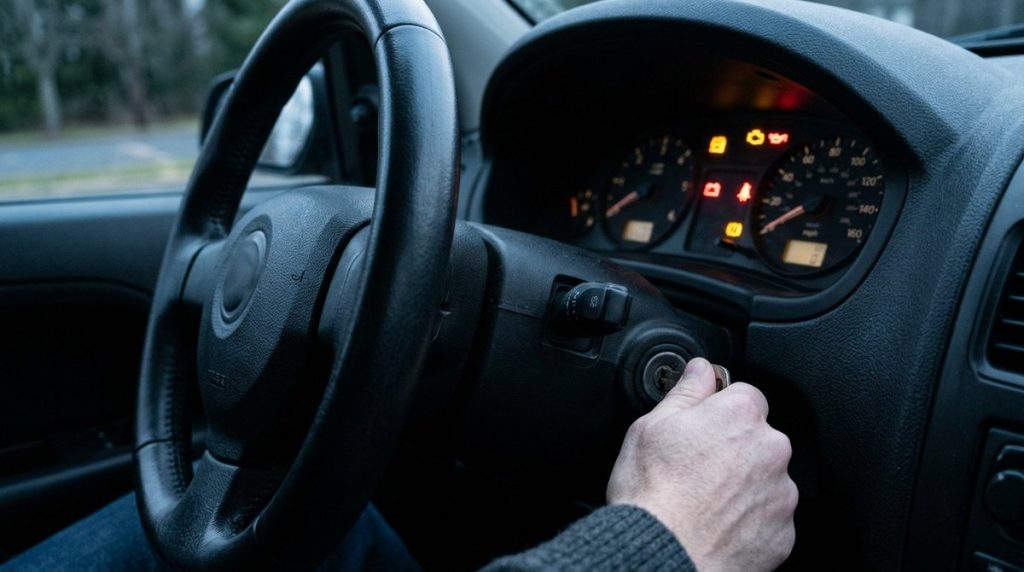
Rapid clicking means the solenoid has just enough power to pull in, but when the starter motor tries to draw its huge current, the battery voltage collapses. The solenoid drops out, the voltage recovers, and it pulls in again, many times a second. Dim or flickering dash lights while you hold the key confirm it. A battery left with the lights on, an old battery in cold weather, or a slow drain overnight are the usual reasons, and our guide to a car battery that keeps dying covers repeat cases. Rapid clicking usually comes with flickering dash lights, which our guide to why dashboard lights flicker and the car won’t start explains step by step.
Rapid clicking with a good battery: bad connections
A battery can test fine and still not deliver current if the terminals are corroded or loose. White or green crust on the posts, a clamp you can twist by hand, or a frayed ground strap between the engine and body all cause the same rapid clicking. Cleaning and tightening the terminals fixes more no-starts than people expect.
One click, then nothing: starter motor or solenoid
A single solid click with bright dash lights means the solenoid engaged, but the motor didn’t turn. Worn starter brushes, a dead spot on the motor’s armature, or burned contacts inside the solenoid are the usual causes. It often starts as an occasional problem before it fails for good, which is a common reason a car starts sometimes but not others. An old trick is to tap the starter with a tool handle while someone turns the key. If the car starts, the starter is on its way out, so treat that as a warning, not a fix.
Clicking from the dash: relay or immobilizer
A quieter click from under the dash or the fuse box comes from a relay, not the starter. A failing starter relay can chatter without sending power on. If a key or security light is flashing, the immobilizer may not recognize your key. Try the spare key before anything else. On push-button cars, a weak key fob battery can cause a no-start too. Many cars let you start by holding the fob right against the start button, where a backup reader sits.
How to narrow it down
- Turn on the headlights and try to start the car. Lights that dim badly point to the battery or connections. Lights that stay bright point to the starter.
- Look at the battery terminals. Clean off any corrosion and make sure the clamps can’t be turned by hand.
- Try a jump start. If it starts right away, the battery or charging system is the problem. If it still clicks once with good jumper cables, suspect the starter.
- With an automatic, try starting in Neutral. If it starts, the gear selector switch may be faulty.
- If you get no click at all and the lights work, see our guide to a car that won’t start but the lights work.
If a warning light stayed on after the car finally started, look up any stored code in our OBD2 code lookup. You can also run your symptoms through the car symptom checker.
How much does it cost to fix?
| Repair | Typical cost |
|---|---|
| Cleaning and tightening terminals | $0–$20 |
| Battery replacement (installed) | $120–$300 |
| Battery cable or ground strap | $50–$200 |
| Starter relay | $20–$100 |
| Starter motor (parts and labor) | $250–$700 |
| Alternator, if the battery keeps going flat | $400–$900 |
Is it safe to jump start?
Usually, yes, if you do it in the right order. Connect red to the dead battery’s positive post, then red to the good battery’s positive post. Connect black to the good battery’s negative post, then the last black clamp to bare metal on the dead car’s engine, away from the battery. Batteries can release flammable gas, so never jump a cracked, leaking, or frozen battery. If the battery is completely dead in winter, getting stranded is the bigger risk, and the NHTSA winter driving tips are worth reading before a cold snap. Don’t keep cranking or tapping for long periods, because a struggling starter can overheat. Never jump a battery that’s swollen or gives off a sulfur smell; our guide to a car battery that smells like rotten eggs explains why. If the car still clicks or stays silent with cables connected, see why a car won’t jump start.
FAQ
Can a bad starter make a rapid clicking sound?
Sometimes, but rapid clicking is far more often a weak battery or a poor connection. A bad starter usually gives one click.
Why does my car click but start after a jump?
Because the battery couldn’t deliver enough current on its own. Have the battery and alternator tested, since one of them is likely failing.
Can a dead battery cause no click at all?
Yes. A completely flat battery may not even power the solenoid, so you get silence and very dim or no lights, as covered in our guide to a car that won’t start with no lights.
Can cold weather make a car click but not start?
Yes. A cold battery delivers much less current, and cold, thick oil makes the engine harder to turn. A battery that was borderline in autumn often gives rapid clicking on the first frosty morning.