
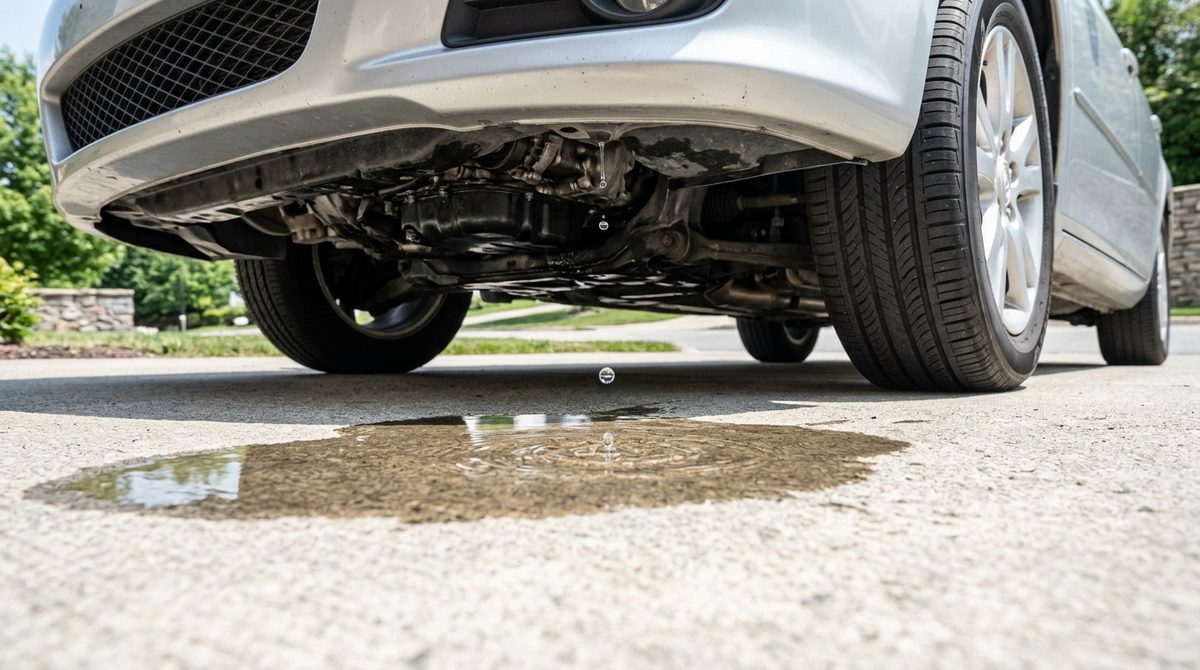
Finding your car leaking water underneath after a hot day is usually nothing to worry about, but the same puddle can also be the first sign of a coolant or brake fluid leak. The color, smell, and location of the drip tell you which one you’re dealing with, and checking takes about two minutes.
In this guide
| What you see | Where | What it probably is | Concern |
|---|---|---|---|
| Clear, no smell, feels like water | Front passenger side or behind the engine | AC condensation | Normal |
| Clear drips from the tailpipe | Exhaust | Exhaust condensation | Normal |
| Green, orange, pink or blue, sweet smell | Front, under the engine or radiator | Coolant | Fix soon |
| Blue and thin, smells like glass cleaner | Front corners | Washer fluid | Low |
| Clear to light brown and slick | Near a wheel or behind the engine | Brake fluid | Stop driving |
| Red or amber and slick | Front or middle | Power steering or transmission fluid | Fix soon |
| Brown or black | Under the engine | Engine oil | Fix soon |
| Strong gasoline smell | Often near the rear | Fuel | Stop driving |
Is a car leaking water underneath normal?
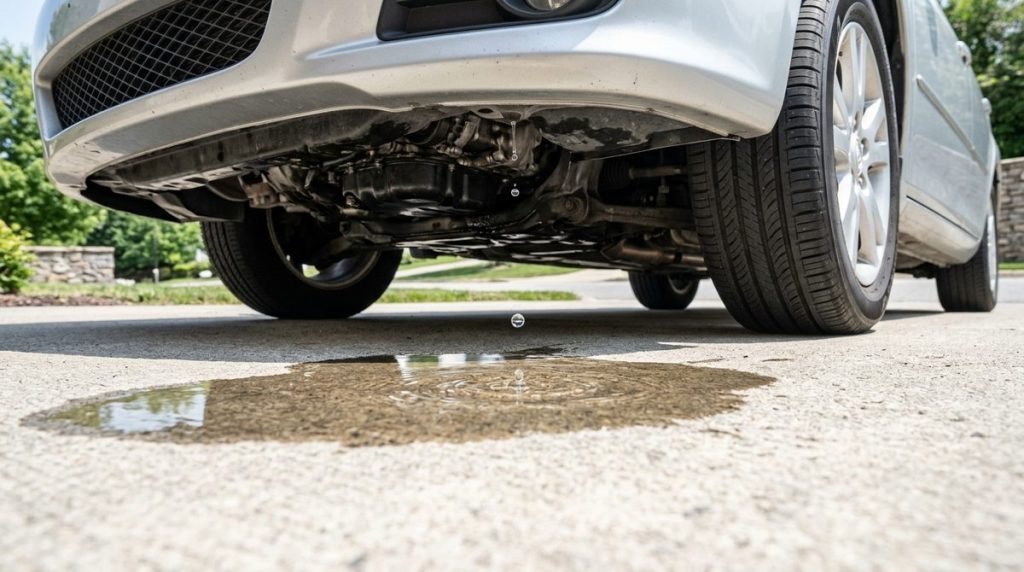
Often, yes. When the AC runs, the evaporator pulls moisture out of the cabin air, and that water drains through a small tube that usually exits under the car near the front passenger side or behind the engine. On a humid day it can leave a surprisingly large puddle. Many cars also run the AC compressor in defrost mode, so you can see drips in cooler weather too.
The tailpipe can drip clear water as well, especially on short trips in cold weather, because water is a normal byproduct of burning fuel. It’s the same reason you see white smoke from the exhaust when it’s cold.
Rain and car washes leave water behind too. It drains from the body seams, the door bottoms, and the sunroof drain tubes, which often exit just behind the front wheels, so dripping for an hour or so after a wash is normal.
If the AC water ends up on the floor inside the car instead of underneath it, the drain is blocked. See our guide to a car AC leaking water inside.
How to check what’s leaking
- Park on a clean surface and slide a sheet of white paper or cardboard under the drip overnight.
- Check the color against the white background.
- Rub a drop between your fingers. Water feels like water, while most other fluids feel slippery or oily.
- Smell it. Coolant smells sweet, washer fluid smells like alcohol or glass cleaner, and fuel is unmistakable.
- Note exactly where the drip lands compared with the wheels and the engine.
- Check the fluid levels under the hood. A reservoir that keeps dropping confirms the source.
Leaks that aren’t water
Coolant
Coolant is often mistaken for water because it can look almost clear when diluted. The sweet smell gives it away. Common sources are hoses, the radiator, and the water pump. A slow coolant leak can make the heater blow cold air and eventually cause overheating. Clean up spills right away, because coolant is toxic to pets and children. If you notice a sweet smell as well as a colored puddle, see why your car smells like antifreeze.
Washer fluid
A cracked reservoir or a loose hose leaks blue fluid near a front corner, and the washers may stop spraying. Our guide to a windshield washer not working covers the usual causes.
Brake fluid
Brake fluid is clear to light brown and feels slick. If you find it near a wheel or under the master cylinder at the back of the engine bay, don’t drive the car. A brake fluid leak can make the brake pedal go to the floor. If you also see the brake warning light on your dashboard, treat any slick puddle near a wheel as brake fluid. If the drip sits right behind a front tire, our guide to fluid leaking near the front wheel helps pin down the source.
Power steering and transmission fluid
Both are usually red or amber. Power steering leaks tend to show up near the front and can make the steering wheel hard to turn. Transmission leaks usually appear under the middle of the car.
Engine oil
Oil is light brown when fresh and dark brown or black when old, and it feels greasy rather than wet. Drips under the front or middle of the engine usually come from the oil pan gasket, the drain plug, or a valve cover gasket. Check the dipstick, and keep the level topped up until it’s fixed. An oil leak that goes unnoticed can eventually leave the oil light flickering at idle.
Fuel
A gasoline puddle or a strong fuel smell is a fire risk. Don’t start the engine, and see what to do when your car smells like gas.
How much does it cost to fix?
| Leak | Typical repair cost |
|---|---|
| AC condensation | Free, it’s normal |
| Clearing a blocked AC drain | $0–$100 |
| Coolant hose | $100–$300 |
| Water pump | $300–$750 |
| Radiator | $400–$1,000 |
| Washer fluid reservoir or hose | $50–$200 |
| Brake line or caliper leak | $150–$450 |
| Power steering hose | $150–$400 |
Is it safe to drive?
Clear, odorless water from the AC drain or the tailpipe is completely safe. With a coolant leak, a short trip is fine only if the temperature gauge stays normal and the reservoir is topped up. Don’t drive with a brake fluid or fuel leak. If a warning light is on as well, look up the code with our OBD2 code lookup, or run your symptoms through the car symptom checker. Some coolant and fuel leaks are covered by recalls, so it’s worth checking the NHTSA recall lookup too.
FAQ
Why is my car leaking water when the AC isn’t on?
Many cars run the AC compressor in defrost mode, and the drain can keep dripping for a while after you park. Exhaust condensation is another common source.
How much AC water is normal?
On a hot, humid day, a puddle several inches across after a long drive is normal. It should be clear and odorless.
Can coolant look like water?
Yes. Diluted or old coolant can look almost clear. If it smells sweet or feels slippery, treat it as coolant.
Can I add water if my coolant is low?
In an emergency, plain water will get you to a shop, but it dilutes the antifreeze and its corrosion protection. Have the leak fixed and the system refilled with the right coolant, and never open the radiator cap while the engine is hot.