
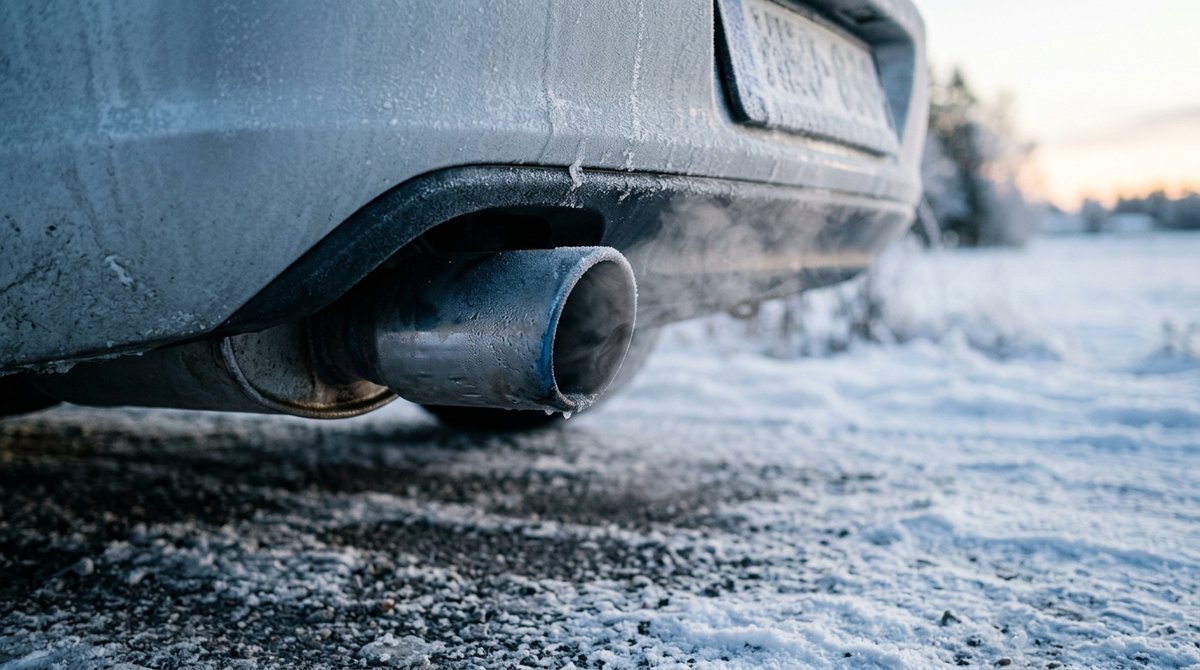
Most white smoke from exhaust when cold is nothing more than steam. Burning fuel produces water vapor, and on a cold morning that vapor condenses into a white cloud the same way your breath does. What you need to know is the difference between harmless steam and the thick, sweet-smelling smoke that means coolant is getting into the engine.
In this guide
Steam vs. coolant smoke at a glance
| Normal condensation | Burning coolant (a problem) | |
|---|---|---|
| How it looks | Thin and wispy, disappears quickly | Thick and billowing, hangs in the air |
| Smell | Normal exhaust smell | Sweet and syrupy |
| When you see it | Cold starts, cold or humid days | Keeps going after the engine is fully warm |
| How long it lasts | Fades after 5–15 minutes of driving | Doesn’t go away |
| Coolant level | Stays the same | Drops with no visible leak |
Why white smoke from exhaust when cold is usually normal
Every gallon of fuel your engine burns produces water as well as carbon dioxide. When the exhaust system is cold, that water vapor condenses as it leaves the tailpipe, and in cold air it shows up as a white cloud. You may also see a few drips of water from the tailpipe. Both are normal. The same condensation can drip from the tailpipe, one of the normal reasons for a car leaking water underneath.
As the engine and exhaust warm up, the steam fades. On very cold or humid days it can last longer, and on short trips the exhaust may never get hot enough to clear it completely. A regular longer drive helps dry out the exhaust system and reduces rust inside the muffler. The steam usually clears once you drive; see how long to warm up a car for how long to idle first.
When white smoke means trouble
1. A blown head gasket
The head gasket seals the gap between the engine block and the cylinder head. When it fails, coolant can leak into the cylinders and burn, producing thick, sweet-smelling white smoke. Other clues include a coolant level that keeps dropping, bubbles in the coolant reservoir with the engine running, overheating, and a rough start after the car has been sitting. Coolant in one cylinder often causes a misfire code like P0301. If a shaky idle comes with the smoke on cold starts, read about a rough idle when cold.
2. A cracked cylinder head or engine block
These usually follow serious overheating, or freezing in a car with weak or watered-down antifreeze. The symptoms look like a head gasket failure, and the repair is more expensive. If the engine overheats with a full coolant reservoir, read car running hot but coolant is full.
3. A leaking intake manifold gasket
On engines where coolant passes through the intake manifold, a failed gasket can let small amounts of coolant into the engine. The smoke is usually lighter than with a head gasket failure.
4. Diesel engines
White or gray smoke on a cold start is common on diesels and usually comes from fuel that didn’t fully burn. It typically clears as the engine warms. If it doesn’t, or it smells strongly of fuel, the glow plugs, injectors, or compression may need checking.
What other colors mean
Blue-gray smoke means the engine is burning oil. Black smoke means it’s burning too much fuel. Both are different problems from white smoke.
How to check it yourself
- Do the warm-up test. Drive for 15 to 20 minutes. If the smoke disappears, it was condensation.
- Track your coolant level. With the engine cold, note the level in the reservoir, then check it again every couple of days for a week.
- Smell it. A sweet smell from the tailpipe means coolant.
- Watch the coolant reservoir with the engine running. Steady bubbles can mean exhaust gas is getting into the cooling system. Don’t open the cap on a hot engine.
- Check the oil. Milky, tan sludge on the dipstick can point to coolant in the oil. A little milky residue under the oil cap after short winter trips is often just condensation, so check the dipstick too.
If any of these point to coolant, a shop can confirm it with a cooling system pressure test, a combustion leak test that detects exhaust gas in the coolant, or a compression test.
Protect your engine before the cold sets in
Some of the worst coolant problems start in winter. If the antifreeze has been watered down by years of top-ups with plain water, it can freeze on a very cold night, and freezing coolant can crack a cylinder head or engine block. Checking it is easy: an inexpensive coolant tester from an auto parts store shows how much protection you have. If it’s weak, a coolant flush with the type your owner’s manual specifies is cheap insurance, especially compared with the repairs in the table below.
How much does it cost?
| Test or repair | Typical cost |
|---|---|
| Cooling system pressure test | $50–$150 |
| Combustion leak (block) test | $50–$150 |
| Compression or leak-down test | $100–$250 |
| Intake manifold gasket | $300–$900 |
| Glow plugs (diesel, set) | $150–$600 |
| Head gasket replacement | $1,000–$3,000+ |
| Cylinder head repair or replacement | $1,500–$4,000 |
Before approving a big repair like a head gasket, enter your VIN in the NHTSA recall lookup. If a recall covers the problem, the dealer fixes it for free.
Can I keep driving?
If it’s normal condensation, yes. There’s nothing to fix.
If it’s coolant, limit your driving and get it diagnosed soon. An engine that’s losing coolant can overheat, and overheating can turn a head gasket repair into a ruined engine. Burning coolant can also damage the catalytic converter. Watch the temperature gauge closely, and if it climbs, pull over and let the engine cool. Topping up the coolant can get you to a shop, but it isn’t a fix. Our guide to car overheating then going back to normal covers what to watch for.
If your car is also struggling to start on cold mornings, read car won’t start in cold weather. For any check engine light, look up the code in our OBD2 code lookup, or start from symptoms with the free car symptom checker.