
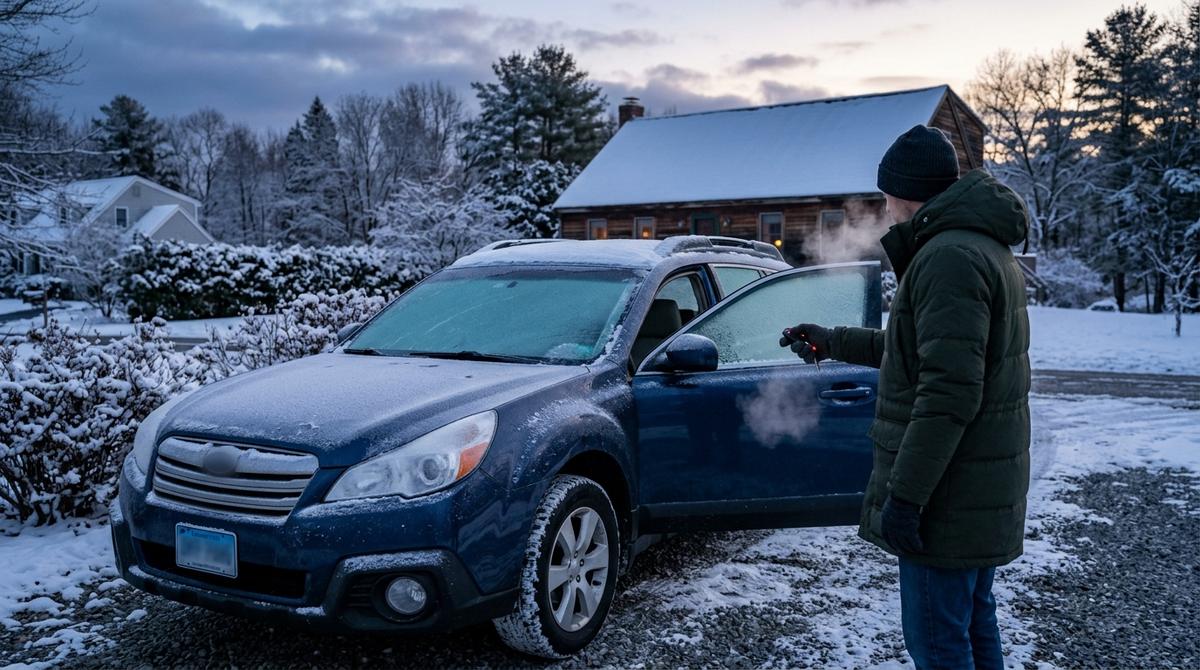
Cold is hard on cars in a very particular way. The battery has less power to give at the exact moment the engine needs more to turn over, so a car that started fine all autumn can suddenly click or crank slowly on the first frosty morning. When a car won’t start in cold weather, the battery is the prime suspect, but it isn’t the only one, and a few minutes of checking can save you a tow.
In this guide
Quick answer
| What happens | Likely cause |
|---|---|
| Slow, labored cranking | Weak battery, or oil too thick for the cold |
| Clicking but no crank | Battery too weak to turn the starter, or corroded terminals |
| Nothing at all, dash dark | Dead battery |
| Cranks normally but won’t fire | Frozen fuel line, weak fuel pump, or flooded engine |
| Diesel cranks but won’t start | Glow plugs or gelled fuel |
| Push-button car won’t recognize the key | Weak key fob battery |
Why cold weather makes starting harder
Three things happen at once when the temperature drops. The chemical reaction inside the battery slows down, so it can deliver noticeably less cranking power than on a mild day. Engine oil thickens, so the starter has to work harder to turn the engine. And fuel doesn’t vaporize as easily, so the engine is harder to fire even once it’s spinning. If your car squeals when starting in cold weather, the belt may be slipping. If you can’t even get in, see our guide to a car door frozen shut before you try to start it.
A healthy battery handles all of that. A battery that’s three to five years old, or one that’s been run down by short trips, often doesn’t. That’s why the first cold snap of the year brings a wave of dead batteries. NHTSA’s winter driving tips recommend having the battery and charging system checked before winter for exactly this reason.
7 reasons a car won’t start in cold weather
1. A weak or aging battery
This is the most common cause by far. Batteries usually last three to five years, and cold weather is what exposes the weak ones. Most auto parts stores will load test your battery for free in a few minutes. If yours keeps going flat even in mild weather, read car battery keeps dying. If the cold morning brings rapid clicking instead of cranking, read what it means when a car clicks but won’t start.
2. Corroded or loose battery terminals
A connection that’s just barely good enough in summer can fail in the cold, when the starter needs every amp. Look for white or green crust on the terminals and check that both clamps are tight. If the dash stays completely dark, see car won’t start and no lights.
3. Oil that’s too thick
The first number in your oil’s rating, like the 0 in 0W-20 or the 5 in 5W-30, describes how well it flows when cold. Using a thicker grade than your owner’s manual specifies, or running well past an oil change, makes cold starts harder.
4. A frozen fuel line or water in the fuel
Moisture can condense inside a nearly empty fuel tank and freeze in the lines on very cold nights. Keeping the tank at least half full in winter reduces the risk. A bottle of fuel line antifreeze made for your type of fuel can help if you suspect water.
5. A starter or fuel pump that’s already weak
Cold makes a struggling starter turn even slower, and a tired fuel pump may not build enough pressure. If you’ve noticed slow cranking or long cranking times before winter, one of these may be on its way out. If it also fails on warm days at random, see car starts sometimes but not others. A key that won’t move at all is a different problem from slow cranking, covered in our guide to why a key won’t turn in the ignition.
6. Diesel trouble: glow plugs and gelled fuel
Diesel engines rely on glow plugs to heat the cylinders for a cold start. Always wait for the glow plug light on the dash to go out before cranking. In very cold weather, diesel fuel can also gel and clog the filter, which is why winter-blend diesel and anti-gel additives exist. Add anti-gel before the cold arrives; it won’t fix fuel that has already gelled.
7. A weak key fob battery
Coin batteries lose power in the cold. If your push-button car doesn’t recognize the key, hold the fob right against the start button. Most cars will start that way. If the security light is flashing, our guide on car won’t start but battery is good covers immobilizer problems.
What to do when it won’t start right now
- Turn everything off before cranking: headlights, heater fan, radio, rear defrost, and seat heaters.
- Crank for 5 to 10 seconds at most, then wait 30 to 60 seconds before trying again. The pause lets the battery recover and keeps the starter from overheating.
- If you smell fuel after several tries, the engine may be flooded. On most fuel-injected cars, holding the gas pedal to the floor while cranking cuts fuel and helps clear it.
- Jump-start it carefully, following your owner’s manual. Make the last connection to bare metal on the engine, away from the battery. Never jump a battery whose case is cracked or bulging; a fully discharged battery can freeze, and a frozen battery can be dangerous to charge.
- Once it starts, drive for 20 to 30 minutes. Idling in the driveway barely recharges the battery.
A portable jump starter pack is one of the most useful things you can keep in the car over winter. If cables don’t help on a frozen morning, read why a car won’t jump start before trying again.
How to prevent it next time
Get the battery tested before the cold arrives, and replace it if it’s weak or more than about five years old. Clean the terminals, use the oil grade your manual specifies, and keep the fuel tank at least half full. If you have a garage, use it. If your car has an engine block heater, plug it in for a few hours before you need to leave. And if the car sits for days at a time, a battery maintainer keeps it topped up. While you’re getting the car ready for winter, make sure the washers work too; see windshield washer not working.
How much does it cost?
| Fix | Typical cost |
|---|---|
| Battery load test | Free at most parts stores |
| Clean battery terminals | $0–$20 |
| Key fob battery | $3–$10 |
| Fuel line antifreeze | $5–$15 |
| Oil change with the correct grade | $50–$120 |
| New battery, installed | $150–$400 (AGM batteries cost more) |
| Engine block heater, installed | $150–$400 |
| Glow plugs (diesel, set) | $150–$600 |
| Starter motor | $300–$700 |
Can I keep driving after a jump?
Yes, but treat it as a warning. A battery that needed a jump on a cold morning is often near the end of its life, so get it tested within a few days, before the next cold snap leaves you stranded. If the battery light stays on after the car starts, the problem is the charging system, not the battery; read battery light on while driving before you go far.
If you see a white cloud from the tailpipe after a cold start, that’s usually just condensation; our guide to white smoke from exhaust when cold explains how to tell. If a check engine light came on after a hard start, look up the code in our OBD2 code lookup, or try the free car symptom checker. Once it’s running, you don’t need to idle for long; see how long to warm up a car.