
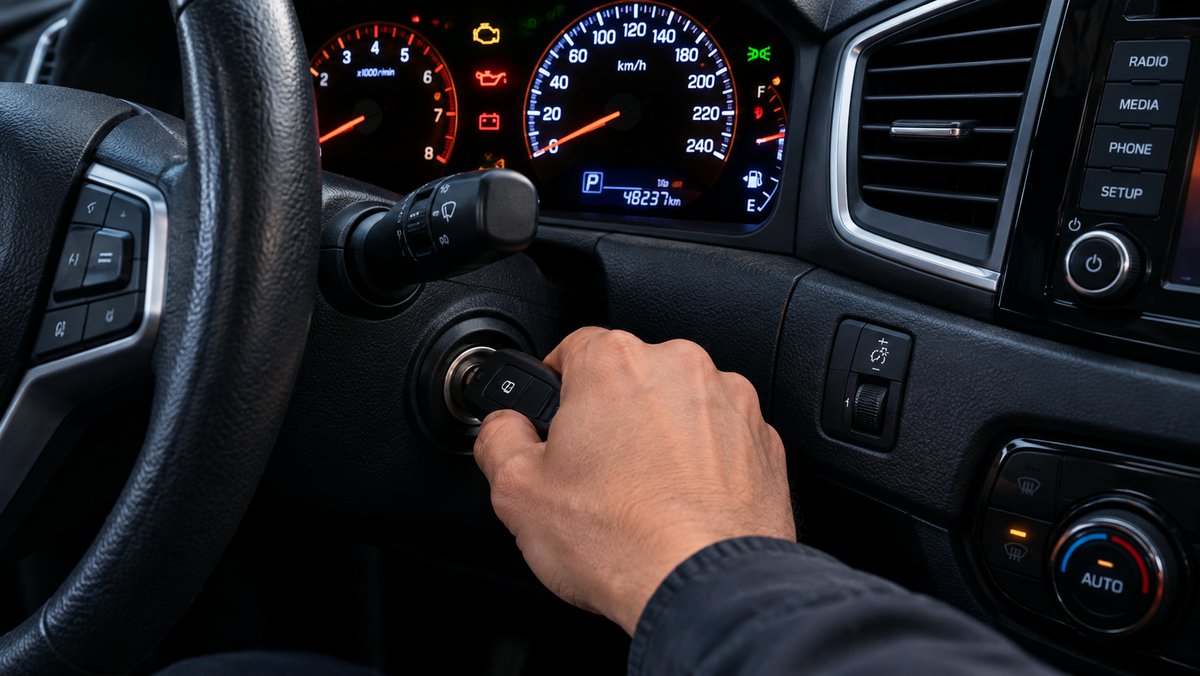
Car won’t start but battery is good? That’s one of the most frustrating spots to be in, because you’ve already ruled out the obvious. The battery is new, or it tested fine, or you jumped it and nothing changed. The upside is that it narrows things down, and the sound the car makes when you turn the key or press the start button tells you most of what you need to know.
In this guide
Quick answer
| What happens when you try to start | Most likely cause |
|---|---|
| Nothing at all, but dash lights come on | Starter relay, fuse, ignition switch, or neutral safety switch |
| One loud click | Starter motor or starter solenoid |
| Rapid clicking | Loose or corroded battery terminals, or a battery that’s weak under load |
| Engine cranks normally but won’t fire | Fuel pump, crankshaft position sensor, or no spark |
| Starts, then dies within a second or two | Immobilizer or key chip problem |
First, make sure the battery really is good
This sounds backwards, but it matters. A battery can read 12.6 volts on a meter and still collapse the moment the starter asks for 150-plus amps. That’s called a surface charge, and it fools a lot of people. A proper load test, which most auto parts stores do for free, is the only way to know for sure. If the trouble started when the temperatures dropped, see car won’t start in cold weather. If a jump didn’t help either, our guide to why a car won’t jump start covers the next checks.
The other trap is the connection. A perfect battery with a corroded or loose terminal acts like a dead one. Grab each clamp and try to twist it. If either one moves, or you see white or green crust, clean both terminals with a wire brush and tighten them. If your battery keeps going flat for no obvious reason, our guide on why your car battery keeps dying covers that. And if the lights work but the engine won’t crank at all, see car won’t start but lights work.
8 likely causes when the battery is fine
1. Bad battery cables or ground strap
Beyond the terminals, check the thick cable that runs from the battery to the starter and the ground strap between the engine and the body. A corroded ground can cause the classic “click, nothing” even with a healthy battery. It’s the cheapest fix on this list, so rule it out first.
2. Failing starter motor or solenoid
One solid click and then silence usually points here. The solenoid is getting power and trying to engage, but the motor isn’t turning. Starters often fail gradually, so you may have had slow or occasional no-starts before this. The old trick of tapping the starter while someone turns the key sometimes gets you home, but it’s a sign the starter is on its way out, not a fix. A single click with a good battery usually points to the starter, which our guide to a car that clicks but won’t start explains.
3. Starter relay or blown fuse
If there’s no click at all, check the starter relay in the fuse box under the hood. On many cars you can swap it with an identical relay, like the horn relay, to test it. If the car starts, you’ve found a $15 problem. Check the ignition and starter fuses while you’re there.
4. Neutral safety switch or clutch switch
Automatic cars only crank in Park or Neutral, and a sensor called the neutral safety switch (or range sensor) confirms which gear you’re in. If it’s worn or out of adjustment, the car thinks it’s in gear and refuses to crank. Try starting in Neutral. If it fires up, that’s your culprit. On a manual, press the clutch all the way to the floor. A weak clutch switch does the same thing.
5. Ignition switch
The ignition switch sends the “start” signal. When it wears out, you might get dash lights but no crank, or the dash flickers as you turn the key. If wiggling the key changes anything, that’s a big clue.
6. Fuel not reaching the engine
If the engine cranks strongly but won’t catch, it may not be getting fuel. Turn the key to ON (not start) and listen near the back of the car. You should hear a quiet hum for about two seconds as the fuel pump primes. No hum points to the fuel pump, its relay, or its fuse. And yes, check the fuel gauge. A faulty sending unit can show a quarter tank when the tank is actually empty.
7. Crankshaft position sensor
This sensor tells the engine computer where the crankshaft is so it can time spark and fuel. When it fails, the engine cranks fine but never fires. A classic clue is the tachometer needle not moving at all while you crank. These sensors often fail when hot, so the car might start again after it cools down. A scanner will usually show P0335 or a related code, which you can check in our OBD2 code lookup. If the no-start comes and goes, see car starts sometimes but not others for how to track the pattern.
8. Immobilizer or key problem
Modern cars won’t run unless they recognize your key. If the security light on the dash flashes when you try to start, the car isn’t reading the chip in your key or fob. Try your spare key first. On push-button cars, a dead fob battery is common, and most will still start if you hold the fob right against the start button. Your owner’s manual shows the exact spot.
How much does it cost to fix?
| Repair | Typical cost |
|---|---|
| Clean and tighten battery terminals | $0–$20 |
| Fuse | $1–$10 |
| Key fob battery | $3–$10 |
| Starter relay | $10–$40 |
| Neutral safety switch | $100–$300 |
| Crankshaft position sensor | $120–$350 |
| Ignition switch | $150–$400 |
| Starter motor | $300–$700 |
| Fuel pump | $450–$1,100 |
Car won’t start but battery is good: quick tips before you call a tow
- Don’t crank for more than about 10 seconds at a time. Wait 30 seconds between tries so the starter doesn’t overheat.
- If you smell fuel after a lot of cranking, the engine may be flooded. On most fuel-injected cars, holding the gas pedal to the floor while cranking cuts fuel and helps clear it.
- If the check engine light is on, scan for codes first. They can save hours of guessing.
Can I keep driving if it eventually starts?
You can, but be careful where you go. A failing starter, a weak crank sensor, or a worn ignition switch are all intermittent problems. They tend to work fine for a while, then leave you stuck in a parking lot. Get it checked before a long trip, and avoid shutting the engine off somewhere you can’t easily get help.
If the car starts but the battery light stays on while you drive, that’s a charging problem, not a starting one. Read battery light on while driving before you go far, because the car will eventually die on the road.
Still not sure where to start? Our free car symptom checker walks you through it in under a minute.
Before paying for a repair, check whether your vehicle has an open safety recall using the NHTSA recall lookup, since recall work is done free at the dealer.