
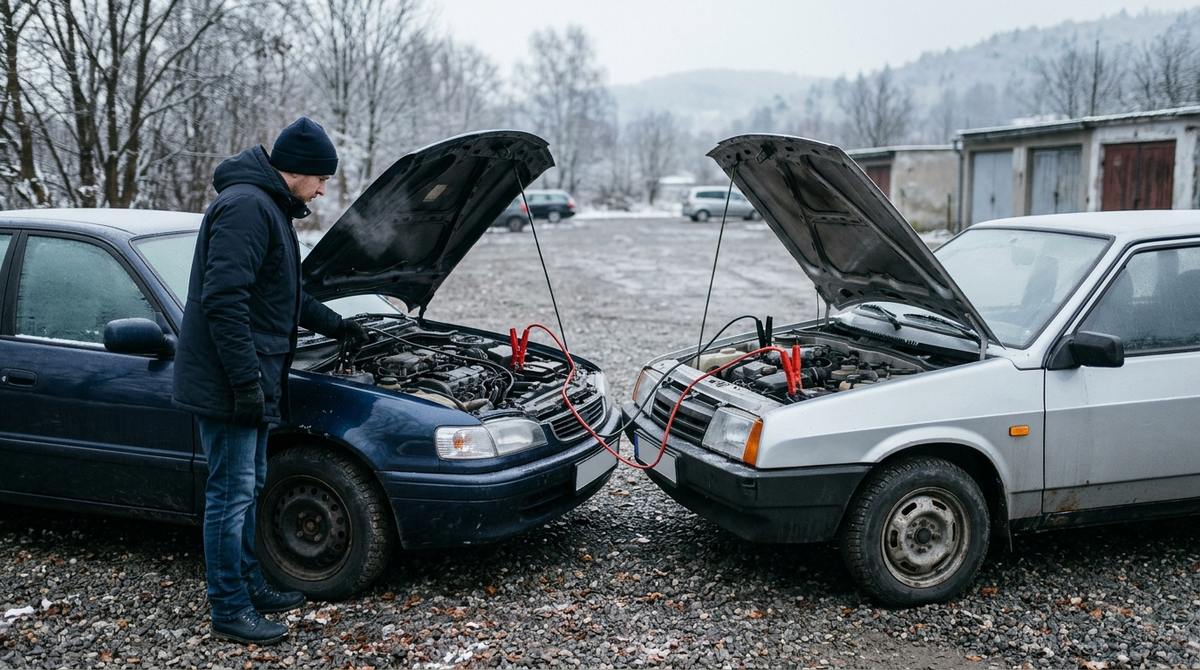
A car won’t jump start for more reasons than a bad battery. If the dash lights come on but the engine still won’t crank, or it cranks and won’t fire, the jump itself may not be delivering enough current, or the problem may not be the battery at all. Working through the causes in order saves a tow and a battery you didn’t need.
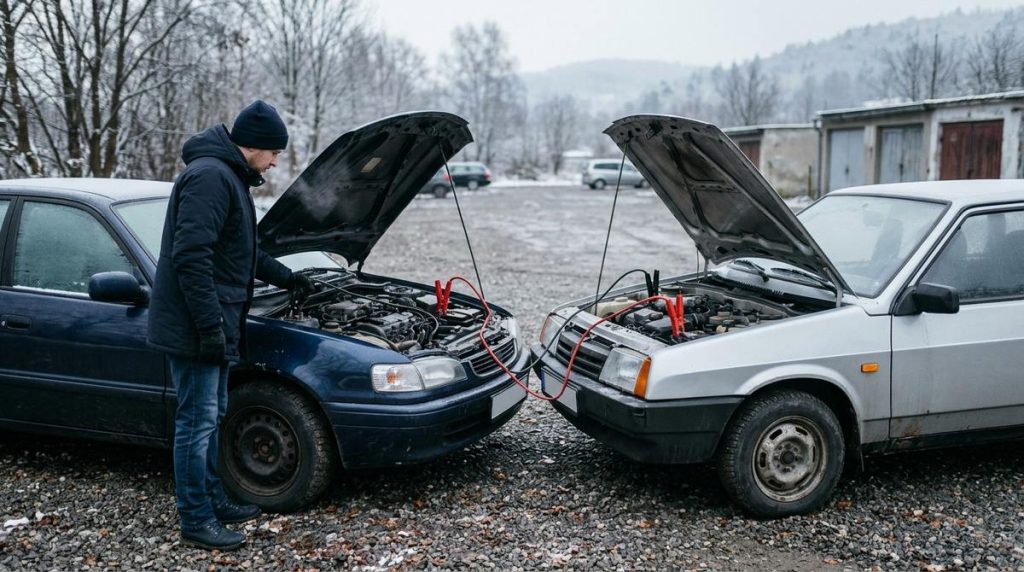
In this guide
| What happens with cables connected | Most likely cause | First thing to try |
|---|---|---|
| Lights come on, rapid clicking, no crank | Poor cable contact or thin cables | Reposition the clamps, wait 5–10 minutes |
| Nothing at all, not even lights | Corroded terminals or a blown main fuse | Clean terminals, check the main fuse |
| One loud click, lights stay bright | Failing starter | Have the starter tested |
| Cranks normally but won’t fire | Fuel, spark, or immobilizer problem | Check for a flashing key light |
| Starts, then dies when cables come off | Failed alternator | Test charging voltage |
| Battery swollen, frozen, or leaking | Damaged battery | Don’t jump it, replace it |
| Worked once, now nothing after a spark or wrong connection | Reversed polarity damage | Check fuses and fusible links |
Why a car won’t jump start: 7 reasons
1. The cables aren’t making good contact
Clamps on painted metal, a corroded terminal, or cheap thin cables can’t carry the heavy current a starter needs. Wiggle each clamp to bite into clean metal, and use cables of at least 6 gauge, preferably 4. Thin cables often make the car click rapidly, like a car that clicks but won’t start.
2. The dead battery needs more time
A completely flat battery soaks up current from the donor car before there’s any left for the starter. Let the donor car run for 5–10 minutes with the cables connected, with its engine at a fast idle, before you try to start. A portable jump starter avoids this problem because it delivers its full current straight away.
3. The battery is damaged
A battery with a shorted cell, a frozen case, or swelling may not respond to a jump at all. Never jump a battery that is swollen, cracked, leaking, or frozen, because it can rupture. If it gives off a sulfur smell, see why a car battery smells like rotten eggs.
4. Corroded or loose terminals on the dead car
If the dead car’s own battery clamps are loose or crusted, the jump current can’t reach the starter even though the cables are clamped on. Clean and tighten them, then try again. If the dash lights flicker every time you try with cables connected, read why the dashboard lights flicker and the car won’t start.
5. A failing starter
If the lights stay bright and you hear one solid click, the starter isn’t turning, and no amount of jump current will help. Our guide to a car that won’t start but the battery is good covers starter tests.
6. A blown main fuse or fusible link
Many cars have a large main fuse or fusible link between the battery and the rest of the car. If it blows, often after a reversed or sparking connection, the car can stay completely dead with or without a jump.
7. It isn’t a battery problem at all
If the engine cranks at normal speed with the cables on but won’t start, the battery has done its job. Look at fuel delivery, spark, or the immobilizer instead. A flashing key or security light points to the immobilizer, and the spare key is the first test. Listen for the fuel pump’s brief hum from the rear when you turn the key to ON. If you hear it, the pump at least has power.
How to jump start correctly
- Park the cars close without touching, both turned off, parking brakes on.
- Red clamp on the dead battery’s positive post, then red on the good battery’s positive post.
- Black clamp on the good battery’s negative post, then the last black clamp on bare, unpainted metal on the dead car’s engine, away from the battery.
- Start the donor car and let it run at a fast idle for 5–10 minutes.
- Try to start the dead car for no more than 5–10 seconds at a time, with a minute’s rest between tries.
- Once it starts, remove the cables in reverse order and keep the engine running for at least 20–30 minutes.
If the car starts but dies again within a day, the battery or alternator is failing, which our guide to a car battery that keeps dying explains. If a warning light stays on afterward, look up the code with our OBD2 code lookup, or use the car symptom checker.
How much does it cost to fix?
| Repair | Typical cost |
|---|---|
| Heavy-duty jumper cables (4 or 6 gauge) | $25–$60 |
| Portable jump starter pack | $60–$150 |
| Cleaning terminals | $0–$30 |
| Battery replacement (installed) | $120–$300 |
| Main fuse or fusible link | $50–$250 |
| Starter motor (parts and labor) | $250–$700 |
| Alternator | $400–$900 |
Is it safe to keep trying?
A few short attempts are fine. Cranking for long stretches overheats the starter, and a battery that’s frozen or swollen can burst, so stop if you see either. Connecting the cables the wrong way round can damage fuses, computers, and the alternator, so double-check polarity every time. In winter, getting stranded is the bigger risk, and the NHTSA winter driving tips cover what to keep in the car.
FAQ
How long should I let a car charge before jump starting?
About 5–10 minutes with the donor car running at a fast idle. A battery that’s completely flat may need longer.
Can a battery be too dead to jump?
Yes. A battery with a shorted cell or one that has been fully discharged for weeks may not accept enough charge to help. It needs testing or replacing.
Why does my car start with a jump and then die?
The battery got the engine started, but the alternator isn’t keeping it running. Have the charging system tested.
Can a bad ground stop a jump start?
Yes. If the engine’s ground strap is corroded or broken, the starter can’t complete its circuit, even with good cables. Clamping the last black cable directly to the engine block can get around it temporarily.
Is a portable jump starter better than cables?
It’s handier because you don’t need a second car, and good ones deliver plenty of current. Keep it charged, especially in winter.