
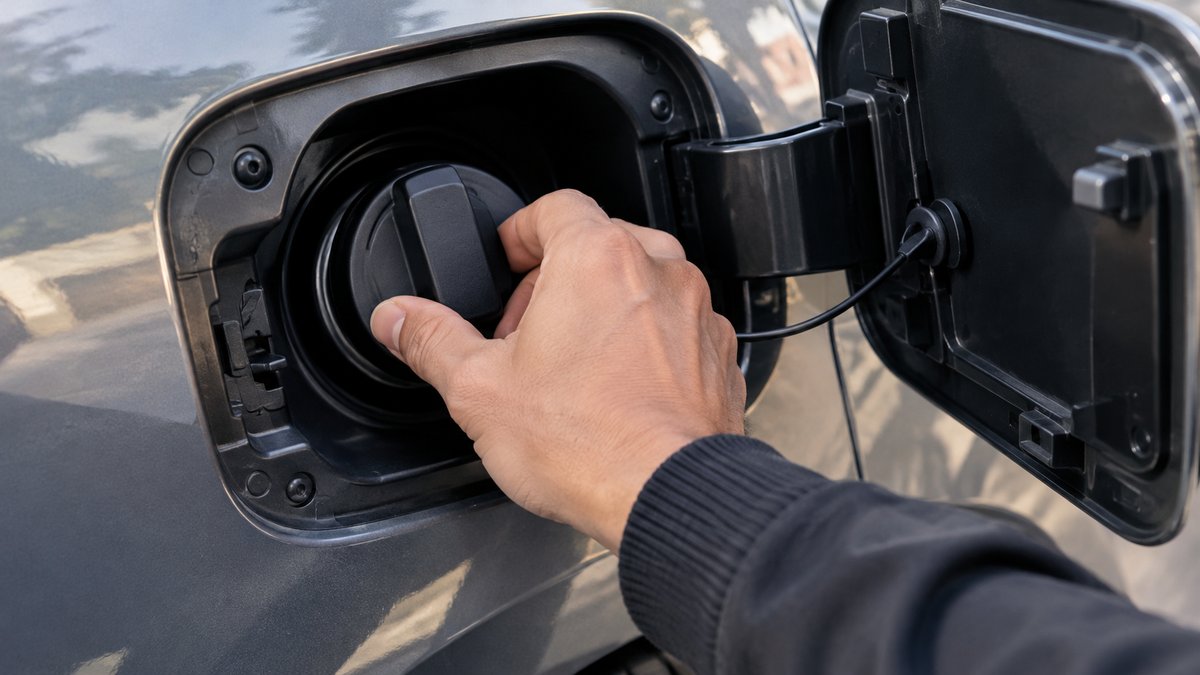
Your check engine light came on, you plugged in a scanner, and it spat out a P0455 code. Before you start pricing repairs, take a breath. This is one of the friendliest codes you can get. It means your car’s evaporative emission system, usually shortened to EVAP, found a large leak. And a surprising amount of the time, that “large leak” is a gas cap that didn’t get clicked shut at the last fill-up.
In this guide
Quick answer
| Question | Short answer |
|---|---|
| What P0455 means | The EVAP system detected a large (gross) vapor leak |
| Most common cause | Loose, damaged, or missing gas cap |
| Other causes | Stuck vent valve, faulty purge valve, cracked hose, damaged charcoal canister, rusted filler neck |
| Safe to drive? | Yes, in the short term. It won’t harm the engine |
| Typical repair cost | $0 to about $600 |
| Will it fail inspection? | Yes, anywhere that does OBD2 emissions testing |
What the EVAP system actually does
Gasoline gives off vapor all the time, especially on hot days. Cars aren’t allowed to vent that vapor into the air, so the EVAP system catches it and stores it in a charcoal canister, usually mounted near the fuel tank. When the engine is warm and running, a purge valve opens and lets the engine pull those stored vapors in and burn them.
Every so often, the engine computer runs a self-test. It closes a vent valve to seal the whole system, then watches whether the system can hold pressure or vacuum. If the reading barely changes, as if the system were wide open, the computer flags a large leak and sets P0455.
P0455 vs P0442 (and P0456)
These three codes come from the same self-test. The difference is how big the leak looks to the computer. If your scanner shows a very small leak instead of a large one, see our guide to the P0456 code.
| Code | What it means | Leak size | Usual suspects |
|---|---|---|---|
| P0455 | Large leak | Roughly as if the cap were off | Gas cap off or loose, disconnected hose, vent valve stuck open |
| P0442 | Small leak | Around 0.040 inch (about 1 mm) | Worn gas cap seal, small hose crack, seeping valve |
| P0456 | Very small leak | Around 0.020 inch (about 0.5 mm) | Cap seal, hairline crack, hard to find without a smoke test |
If you have P0442 instead, almost everything below still applies. Small leaks are just harder to track down, so a smoke test matters more. You can look up both codes, plus related EVAP codes like P0440 and P0446, in our OBD2 code lookup. If your scanner shows a small leak instead, read our P0442 code guide.
Common causes of a P0455 code
1. The gas cap. Start here every time. A cap that wasn’t tightened until it clicked, a cracked rubber seal, a cap left sitting on the pump, or a cheap aftermarket cap that doesn’t seal properly will all set P0455. A new OEM-quality cap costs $15 to $30. If your car has a capless filler (common on newer Fords and some GM models), dirt can stop the spring-loaded flap from sealing. If the light came on right after a fill-up, see why a check engine light after getting gas is so often the cap.
2. A stuck vent valve. The canister vent valve has one job: close during the test so the system can seal. It usually lives under the car near the canister, right where mud, road salt, and even spider webs can get in. If it sticks open, the system can never seal, and the computer reads that as a huge leak. After the gas cap, this is one of the most common causes.
3. A faulty purge valve. On most cars the purge valve sits in the engine bay. When it sticks open, it can upset the test and set P0455, often alongside P0441 or P0496. A telltale sign is a rough idle or hard start right after you fill up.
4. A cracked or disconnected hose. EVAP lines are rubber and plastic, and they get brittle with age. They also get knocked loose during other repairs. Look for a hose hanging free near the purge valve or the canister.
5. A damaged charcoal canister. Canisters crack from impacts or get soaked with liquid fuel, which usually happens when people keep squeezing the pump handle after it clicks off. If you top off your tank, stop. That habit kills canisters.
6. A rusted filler neck. On older cars from snowy states, the metal tube between the gas cap and the tank can rust through. You’ll often smell fuel near the rear wheel on that side.
How to diagnose it, step by step
- Check the cap. Remove it, inspect the rubber seal for cracks, wipe the filler opening clean, and tighten it until it clicks at least once. If the seal looks tired, just replace the cap.
- Give it time. The light won’t go off right away. The EVAP self-test only runs under specific conditions, typically after the car has sat overnight and with the tank somewhere between about a quarter and three-quarters full. Expect a few days to a week of normal driving before the light turns off on its own.
- Look for obvious hoses. With the engine off, trace the lines you can see from the purge valve and around the canister. You’re looking for anything cracked, chewed, or hanging loose.
- Get a smoke test if the code comes back. This is how shops find EVAP leaks properly. They seal the system, pump in harmless visible smoke, and watch where it escapes. It usually costs $100 to $200 and saves you from guessing at parts.
One tip: don’t clear the code with a scanner right before an emissions test. Clearing it resets the readiness monitors, and the test station will turn you away until the car has driven enough to complete them again. If the code won’t clear after you fix the cap, it may be a permanent code, which our guide to pending vs stored vs permanent codes explains.
How much does it cost to fix P0455?
| Repair | DIY parts | Shop price |
|---|---|---|
| Gas cap | $15–$30 | $20–$50 |
| EVAP hose | $10–$50 | $100–$250 |
| Purge valve | $25–$90 | $120–$300 |
| Vent valve | $30–$100 | $150–$350 |
| Charcoal canister | $100–$350 | $250–$600 |
| Filler neck | $60–$200 | $250–$500 |
| Smoke test (diagnosis) | — | $100–$200 |
Most P0455 fixes land at the cheap end of this table. The expensive ones, the canister and filler neck, are much less common.
Can I keep driving with a P0455 code?
Yes. P0455 doesn’t change how the engine runs, and putting off the repair for a while won’t cause damage. Most people won’t feel any difference behind the wheel.
Just don’t ignore it forever. You’ll fail any emissions inspection while it’s set, and you’re letting fuel vapor escape, which wastes a little gas. The bigger risk is quieter: with the check engine light already on, you won’t notice if a second, more serious problem shows up.
Two exceptions. If you smell raw gasoline strongly, around the car or inside it, treat that as more urgent and read our guide on why your car smells like gas. And if the check engine light is flashing rather than steady, that isn’t an EVAP problem. A flashing light usually means an active misfire, so see check engine light flashing.
It only takes a minute to enter your VIN in the NHTSA recall lookup and see whether a free recall repair applies.
Other codes you might see
If your scanner showed more than one code, check those too. A lean code like P0171 can point to a vacuum leak, and we also cover P0420 and P0300. You can look up any code in seconds with our OBD2 code lookup, or try the free car symptom checker if you’re working from symptoms instead.