
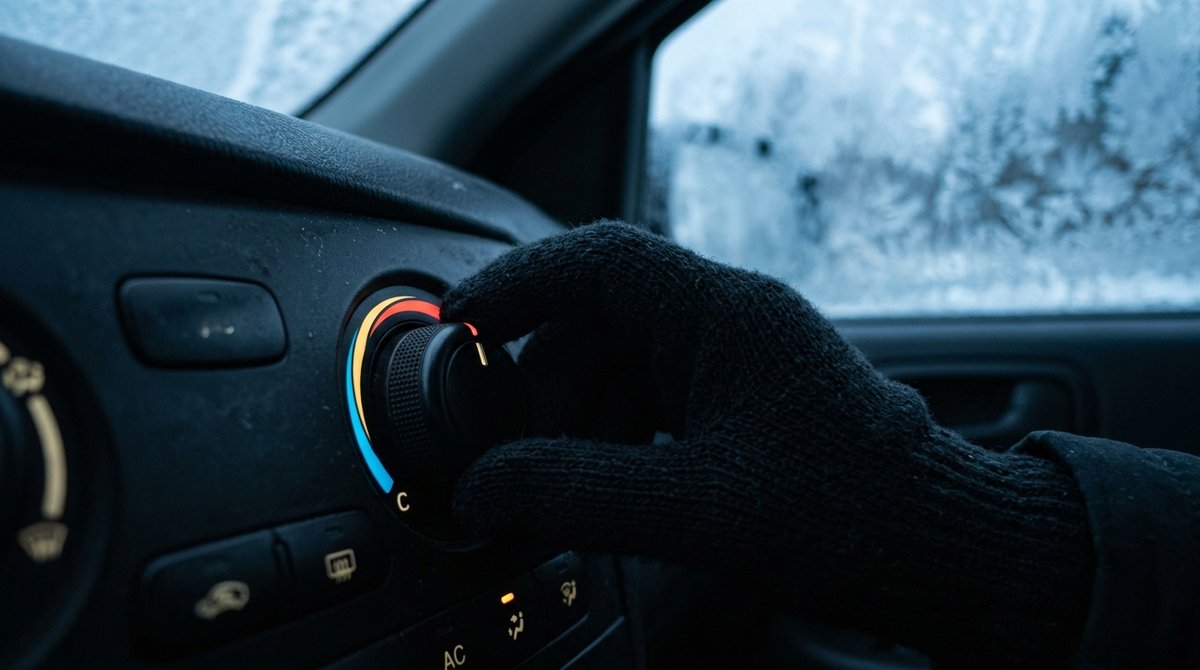
Warm air on the open road, then a cold blast every time you stop at a light. When a car heater only works when driving, the problem is almost always coolant flow. At higher engine speeds the water pump spins faster and pushes enough hot coolant through the heater to hide the problem. At idle, it can’t, and the air from your vents goes cold.
In this guide
Quick answer
| Clue | Likely cause |
|---|---|
| Coolant reservoir below the MIN mark | Low coolant, most likely from a leak |
| Gurgling or sloshing sound behind the dash | Air trapped in the cooling system |
| Heat weak overall, worst at idle | Partly clogged heater core |
| Started right after cooling system work | Air pocket that wasn’t bled out |
| Temperature gauge also climbs at idle | Water pump or cooling fan problem |
| Heat fine at idle but fades on the highway | Thermostat stuck open (the opposite pattern) |
Why idle exposes heater problems
Your heater uses heat from the engine. Hot coolant flows through the heater core, a small radiator behind the dashboard, and the blower pushes cabin air across it. The water pump that moves that coolant is driven by the engine, so at idle it turns slowly. A healthy system still moves plenty of coolant at idle. A system that’s low on coolant, full of air, or partly blocked only gets enough flow when you’re driving and the engine is spinning faster. Driving warms the engine faster than idling; see how long to warm up a car.
6 reasons your car heater only works when driving
1. Low coolant
This is the most common cause. The heater core often sits high in the cooling system, so it’s the first place to lose flow when coolant runs low. Check the reservoir with the engine cold, and never open a hot radiator cap. If it’s low, the coolant went somewhere: look for drips under the car, damp hoses, crusty residue around the radiator or water pump, or a sweet smell inside the car. Damp carpet that smells sweet points to the heater core itself; our guide to car AC leaking water inside explains how to tell coolant from plain water.
2. Air trapped in the cooling system
If the coolant was recently changed or a part was replaced, an air pocket can get stuck in the heater core. You’ll often hear gurgling behind the dash, especially when you first start the car or rev the engine. Many cars need a specific bleeding procedure, using bleeder screws or a spill-free funnel, to get all the air out.
3. A partly clogged heater core
Old coolant, mixed coolant types, and stop-leak products can leave deposits that narrow the passages in the heater core. With the engine fully warm, carefully touch the two heater hoses where they go into the firewall. Both should be hot. If one is hot and the other only warm, coolant isn’t flowing well through the core. A heater core flush often fixes it. If the heat eventually comes but takes far too long even on the move, read why a car heater takes forever to warm up.
4. A weak water pump
A worn or corroded impeller inside the water pump can still move enough coolant at higher rpm but not at idle. Other signs include a coolant drip from a small hole on the pump body, a whining or grinding noise from the front of the engine, and the temperature gauge creeping up in traffic.
5. A sticking heater control valve or blend door
Some cars have a valve that controls coolant flow to the heater core, and it can stick partly closed. Others control heat with a blend door behind the dash. If one side of the car is warmer than the other, see AC blowing hot air on driver side, which covers blend door problems.
6. The opposite pattern: a thermostat stuck open
If your heat is actually better at idle and fades on the highway, that’s a different problem. A thermostat stuck open lets the engine run too cool at speed. It often sets a P0128 code, and our guide to car heater blowing cold air covers it in detail.
How to keep it from happening again
Most heater flow problems come from a cooling system that’s been neglected. Change the coolant on the schedule in your owner’s manual, use only the coolant type it specifies, and avoid mixing different types. Skip stop-leak products unless a mechanic recommends them, since they can clog the heater core along with the leak. And after any cooling system repair, make sure the system is bled properly.
Quick checks you can do
- Check the coolant level with the engine cold.
- Watch the temperature gauge. It should reach its normal position after 10 to 15 minutes of driving.
- Do the rev test. At idle with the heater on full, hold the engine at about 1,500 to 2,000 rpm. If warm air returns almost immediately, the problem is coolant flow.
- Feel the heater hoses as described in cause #3.
- Listen for gurgling behind the dash.
Keep hands and sleeves away from the fan and belts whenever the engine is running.
How much does it cost to fix?
| Repair | Typical cost |
|---|---|
| Coolant top-up | $10–$30 |
| Cooling system bleed | $50–$150 |
| Coolant flush | $100–$200 |
| Heater core flush | $100–$250 |
| Heater hose | $100–$300 |
| Heater control valve | $100–$350 |
| Water pump | $350–$900 |
| Heater core replacement | $800–$2,000 |
Before you approve a big job like a heater core, it’s worth entering your VIN in the NHTSA recall lookup in case a recall or free repair covers it.
Can I keep driving?
A weak heater on its own is a comfort problem. Low coolant is not. If coolant is leaking, the engine can overheat, and an overheated engine can turn a cheap hose repair into a head gasket job. Watch your temperature gauge, and if it climbs, pull over and let the engine cool before checking anything. Our guide to car overheating then going back to normal explains what to do.
Weak heat also means weak defrosting, which matters on cold mornings. If you can’t keep the windshield clear, read defroster not working. For any warning light, our OBD2 code lookup explains the code, and the free car symptom checker can help narrow down other symptoms.