
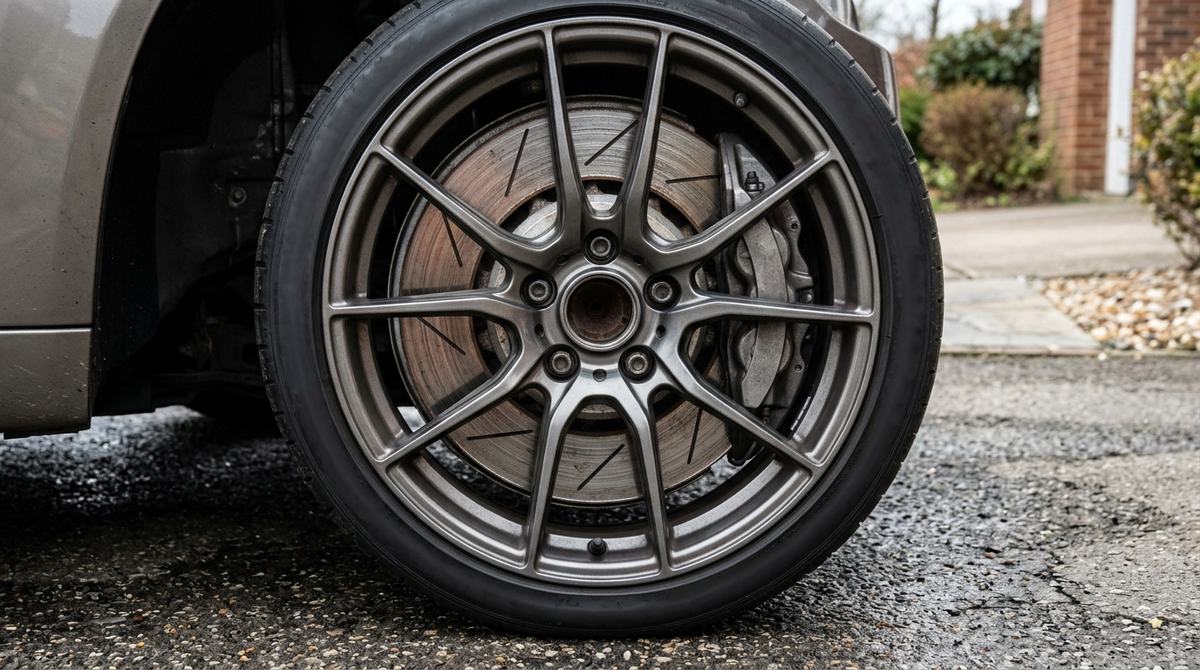
A grinding noise while driving that happens even when your foot is nowhere near the brake pedal points away from normal brake wear and toward the wheels, the hardware behind them, or the drivetrain. The fix can be as simple as flicking out a pebble or as important as replacing a wheel bearing, so it pays to work out which one you have.
In this guide
| What you notice | Most likely cause | Urgency |
|---|---|---|
| Sudden scraping after a gravel road | Stone stuck in the brake dust shield | Low, fix soon |
| Scraping that started after a tire or brake job | Bent dust shield touching the rotor | Low, fix soon |
| Growl or grind that rises with speed and changes when you weave | Worn wheel bearing | High |
| Grinding plus a burning smell or one hot wheel | Sticking caliper or parking brake | High |
| Metal-on-metal grind that gets worse when braking | Pads worn down to the backing plate | High |
| Grinding or clicking mainly when turning or accelerating | CV joint or drivetrain | Medium to high |
What causes a grinding noise while driving
1. A stone in the brake dust shield
The thin metal shield behind each brake rotor can trap small stones. The result is a harsh, constant scrape that often starts right after driving on gravel and may change or stop when you touch the brakes. Rolling slowly in reverse sometimes frees it. If not, a shop can pull the wheel and remove it in a few minutes.
2. A bent dust shield
The same shield bends easily during tire rotations, brake jobs, or a hard pothole hit. If the noise started right after service, a bent shield rubbing on the rotor is a likely suspect. Bending it back takes a few minutes with the wheel off.
3. A worn wheel bearing
A failing wheel bearing usually starts as a hum or growl and turns into a grind as it wears. It rises and falls with road speed, not engine speed, and often changes when you swerve gently left and right, because that shifts weight onto or off the bad bearing. If the noise gets louder when you turn left, the right-side bearing is often the one being loaded, and the other way around. Advanced wear can also cause play in the wheel or a vague, wandering steering feel. If a worn bearing has also triggered the ABS light on your dashboard, our guide explains what that warning means. If the sound is more of a steady drone than a grind, see the causes of a humming noise when driving.
4. A sticking caliper or parking brake
If a caliper piston or slide pin seizes, the pad drags on the rotor all the time. You may notice grinding, a burning smell, the car pulling to one side, and one wheel much hotter than the others after a drive. A parking brake that didn’t fully release can do the same thing at the rear wheels, so check it first.
5. Brake pads worn down to metal
Pads normally squeal near the end of their life. If that warning was missed, the steel backing plate can grind against the rotor. This is loudest when braking, but a lightly dragging pad can grind while cruising too. Our guide to a grinding noise when braking covers that situation in detail, and brake pads vs rotors explains what usually needs replacing.
6. A CV joint or drivetrain problem
On front-wheel-drive cars, a worn outer CV joint usually clicks on tight turns, which our clicking noise when turning guide covers. A badly worn joint can grind instead. A noise that changes when you press or release the throttle, rather than with road speed, points to the differential, transfer case, or transmission, the same territory as a car making noise when accelerating.
How to pin down the source
- Note when it happens: all the time, only above a certain speed, only when turning, or only on and off the throttle.
- Make sure the parking brake is fully released.
- On a quiet, empty road, weave gently. A noise that changes as you weave suggests a wheel bearing.
- After a short drive, hold your hand near (not on) each wheel. One that gives off much more heat than the others suggests a dragging brake.
- With the car parked safely, look through the wheel spokes at the rotor surface and the shield behind it.
If the check engine light or ABS light came on at the same time, read the codes and decode them with our OBD2 code lookup, since a failing bearing can upset the wheel speed sensor. The car symptom checker can help if the noise comes with other symptoms.
How much does it cost to fix?
| Repair | Typical cost (parts and labor) |
|---|---|
| Remove a stone from the dust shield | $0–$50 |
| Straighten a bent dust shield | $0–$80 |
| Wheel bearing or hub assembly (one wheel) | $200–$600 |
| Caliper replacement (one side) | $150–$400 |
| Brake pads and rotors (one axle) | $250–$600 |
| CV axle replacement | $200–$700 |
| Differential fluid service | $100–$200 |
Is it safe to drive?
A pebble in the shield is annoying but not dangerous. A worn wheel bearing, a dragging caliper, or pads worn to metal are a different story. A bearing can fail completely and, in rare cases, let the wheel wobble or lock, and a dragging brake can overheat and lose stopping power. If the grinding gets louder quickly, comes with a burning smell, or the steering wheel starts to shake, stop and have the car towed or inspected. Wheel bearing and hub recalls do happen, so check your car on the NHTSA recall lookup before paying for the repair.
FAQ
Can a wheel bearing make a grinding noise?
Yes. Early on it usually hums or growls, and as it wears it can grind, especially at highway speed or in long corners.
Why does the grinding stop when I press the brake?
Pressing the brake can push a trapped stone or a slightly bent shield out of contact for a moment. That pattern points to the dust shield rather than worn pads.
Is grinding while driving always the brakes?
No. Wheel bearings, CV joints, and the differential can all grind without the brakes being involved.
How long can you drive with a bad wheel bearing?
There’s no safe number. A bearing that only hums may last weeks, but one that grinds, gets louder every day, or lets the wheel wobble should be replaced right away.