
Brake pads vs rotors is one of the most common questions at any service counter. Maybe your brakes started making noise, or a shop just told you that you need “pads and rotors” and you’re wondering if that’s really true. Pads and rotors work as a team, but they wear at different rates and give different warning signs. Once you know what to look and listen for, you can usually tell which one is the problem.
In this guide
Quick answer
| Sign | Points to |
|---|---|
| High-pitched squeal when braking | Brake pads getting thin |
| Grinding or scraping | Pads worn to metal, rotors now being damaged |
| Vibration in the pedal or steering wheel when braking | Rotors (uneven thickness or deposits) |
| Deep grooves or a raised lip on the rotor edge | Rotors |
| Pad material under 3 mm (about 1/8 inch) | Brake pads |
| Blue or dark heat spots on the rotor | Rotors overheated |
What pads and rotors actually do
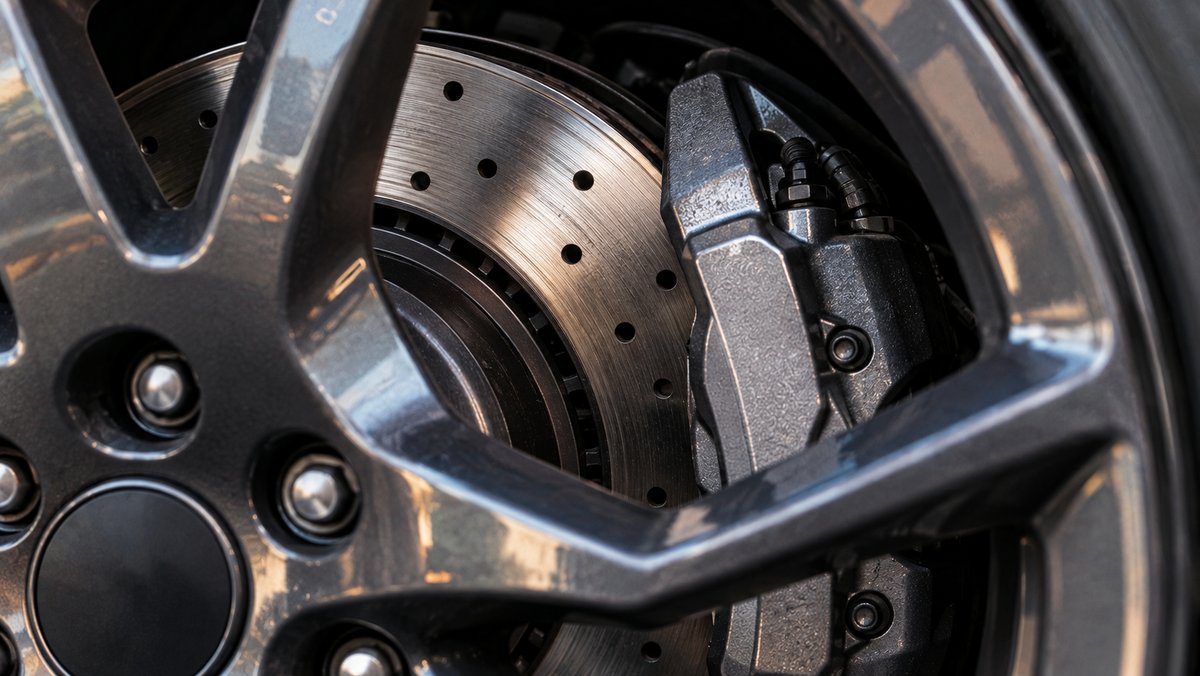
The rotor is the large metal disc you can see through your wheel spokes. It spins with the wheel. The brake pads sit inside the caliper, which straddles the rotor. When you press the pedal, the caliper squeezes the pads against both sides of the rotor, and friction slows the car.
Pads are designed to wear out. They’re the softer part. Rotors wear too, just much more slowly, and they can be damaged by heat or by pads worn down too far.
| Brake pads | Rotors | |
|---|---|---|
| What it is | Friction material clamped by the caliper | Metal disc that spins with the wheel |
| Typical lifespan | 30,000–70,000 miles | 50,000–80,000 miles, often two sets of pads |
| Main warning sign | Squealing | Pulsing pedal or steering shake |
| Typical shop cost per axle | $150–$300 | $300–$700 (with new pads) |
Driving style changes these numbers a lot. City driving, towing, and heavy SUVs wear brakes much faster than easy highway miles.
Signs your brake pads need replacing
Squealing. Most pads have a small metal tab called a wear indicator. When the pad gets thin, the tab touches the rotor and squeals, usually when you brake and sometimes while driving. It’s meant to be annoying so you’ll do something about it. A squeak that disappears after a few stops is usually surface rust; see brakes squeak in the morning. A high-pitched noise in light, slow stops is often the wear indicator, which our guide to why brakes squeal when stopping slowly explains.
Thin pads. Look through the wheel spokes at the caliper and you’ll see the pad pressed against the rotor. If the friction material looks thinner than about 3 mm, roughly two stacked coins, it’s time.
A warning light. Some cars, especially European models, have electronic pad wear sensors that turn on a dash light. As pads wear, the fluid level drops, which is one reason you may see the brake warning light on before you hear any noise.
Longer stops or a softer feel. Worn pads need more pedal pressure to stop the car.
Signs your rotors need attention
Pulsing or vibration when braking. If the pedal pulses or the steering wheel shakes when you brake, especially from highway speed, the rotors usually have uneven thickness or pad material deposits on them. People call this “warped rotors.” Our guide on car shakes when braking at high speed covers it in detail.
Grooves or a lip. With the car parked and the brakes fully cool, look at the rotor surface. Light lines are normal. Deep grooves you can catch with a fingernail, or a raised lip around the outer edge, mean the rotor is worn.
Too thin. Every rotor has a minimum thickness stamped on it, often marked “MIN TH.” A shop can measure it with a micrometer. Below that number, it has to be replaced.
Heat damage. A blue tint or dark hard spots mean the rotor got extremely hot, often from a sticking caliper or riding the brakes down long hills.
If you hear grinding, it’s probably both
Grinding is metal on metal. The pad material is gone and the steel backing plate is scraping the rotor. By then the rotor is almost always damaged too, so you’ll be replacing both. See grinding noise when braking for other causes, like a stone stuck in the brake.
Should you replace rotors every time you replace pads?
Not necessarily. If the rotors are smooth, above minimum thickness, and you don’t feel any vibration, new pads alone are fine. Many shops replace rotors with every pad job anyway, partly because modern rotors are thinner and cheaper than they used to be, which makes resurfacing less worthwhile. Skipping new rotors is one of the most common reasons for brakes grinding after new pads.
A few rules that always apply:
- Replace pads and rotors in pairs on the same axle, both fronts or both rears.
- New pads on badly grooved rotors means noise, weaker braking, and pads that wear out fast.
- New pads need to be bedded in with a series of moderate stops. Most pad boxes include instructions.
- If one side wore much faster than the other, or the car pulls to one side when braking, a caliper may be sticking. Fix that too, or the new parts will wear the same way.
Brake pads vs rotors: how much does each cost?
| Job (per axle) | DIY parts | Shop price |
|---|---|---|
| Pads only | $35–$100 | $150–$300 |
| Pads and rotors | $100–$300 | $300–$700 |
| Resurface rotors (with pad job) | — | $20–$40 per rotor |
| Caliper replacement | $50–$150 each | $250–$600 per pair |
Trucks, performance cars, and European models sit at the top of these ranges or above.
Can I keep driving?
It depends on what you’re hearing and feeling:
- Squealing: you have some time, but plan the job within the next few weeks. Waiting until it grinds turns a pads-only job into pads and rotors.
- Grinding: get it fixed as soon as possible. Braking power is reduced and the damage spreads with every mile.
- Vibration when braking: fine for short-term driving, but it gets worse and can wear suspension parts. Get the rotors checked soon.
- Pedal sinking toward the floor: don’t drive. That’s a hydraulic problem, not pads or rotors. Read brake pedal goes to the floor.
Worn pads and rotors don’t usually set a check engine code, but if your ABS or traction control light is on, your scanner may show a chassis code starting with C. Our OBD2 code lookup can decode it. Not sure what’s going on? Try the free car symptom checker.
Before paying for a repair, check whether your vehicle has an open safety recall using the NHTSA recall lookup, since recall work is done free at the dealer.