
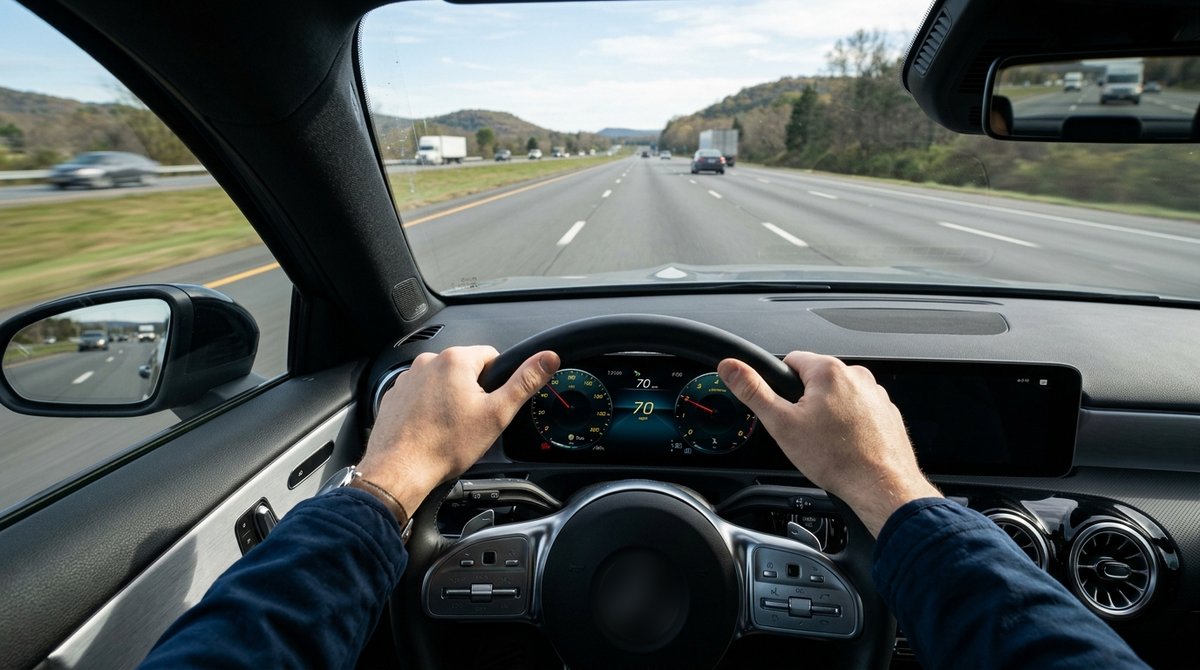
If your steering feels loose at highway speed, you’ll notice it as a vague, floaty feeling in the wheel. You turn it a little and nothing happens, then the car responds all at once, and you find yourself making constant small corrections just to stay in your lane. That “play” in the steering almost always comes from wear somewhere between the steering wheel and the tires, and it’s worth finding sooner rather than later.
In this guide
Quick answer
| What you feel | Likely cause |
|---|---|
| Wheel moves an inch or two before the car responds | Worn tie rod ends or steering rack |
| Car wanders and needs constant corrections | Worn tie rods, ball joints, or alignment |
| Clunk over bumps plus loose feel | Ball joints, control arm bushings, or sway bar links |
| Humming that changes with speed | Worn wheel bearing |
| Loose feel only in crosswinds or on grooved roads | Tires, tire pressure, or alignment |
| Inner or outer edges of the tires wearing fast | Toe alignment out, often from worn tie rods |
Why steering feels loose
Your steering wheel connects to the front wheels through a chain of joints: the steering shaft, the steering rack, the tie rods, and the ball joints that let the wheels pivot. Each joint is tight when new. As they wear, small gaps open up, and those gaps add together. A little play at each joint becomes a noticeable dead zone at the steering wheel, and it’s most obvious at highway speed, where small inputs matter most. If the looseness is mainly a dead spot around the center of the wheel, see our guide to play in steering wheel.
Common causes
1. Worn tie rod ends
Tie rods push and pull the front wheels to steer them. Worn inner or outer tie rod ends are the most common cause of loose steering. They often cause uneven tire wear too, since they let the wheels drift out of alignment. Worn tie rods can also leave the steering wheel off center as well as making it feel vague.
2. Worn ball joints
Ball joints connect the wheel hub to the suspension. When they wear, you may hear a clunk over bumps and feel the car wander. A badly worn ball joint is a real safety risk, so don’t put off a check. If you also hear clicking or knocking when turning, read clicking noise when turning. If you also hear clunks over bumps, check our guide to bad ball joint symptoms.
3. A worn steering rack or its mounts
Wear inside the rack, or tired rubber bushings that hold it in place, can let the whole rack shift slightly before the wheels respond.
4. Worn control arm bushings
Cracked or worn bushings let the suspension move more than it should, which shows up as wandering and clunks.
5. A worn wheel bearing
A loose wheel bearing adds play at the wheel itself. It usually comes with a humming or growling noise that rises with speed.
6. The steering shaft
A worn joint in the intermediate steering shaft can add play and a clunk you feel directly in the steering wheel. If the looseness comes with a knock on rough roads, check the causes of a clunking noise over bumps.
7. Tires and alignment
Low or uneven tire pressure, mismatched or worn tires, and an alignment that’s out can all make steering feel vague. These are the cheapest things to rule out. If the car also drifts in one direction, see car pulling to one side.
Simple checks you can do
- Check tire pressures on all four tires and look for uneven wear.
- Do a dry park check. With the car parked on level ground and the engine off, have a helper rock the steering wheel a few inches each way while you watch the tie rods and joints behind each front wheel. Any visible clunk or lag between parts points to the worn one.
- Rock the wheels. With the front raised and safely supported on jack stands, grab each tire at the top and bottom and rock it. Play there suggests ball joints or a wheel bearing. Then grab it at the sides and rock it. Play there points to a tie rod end.
Never work under a car held up only by a jack.
What a shop will check
A good shop will put the car on a lift and check every joint in the steering and suspension for play, including the tie rods, ball joints, control arm bushings, wheel bearings, and the steering rack mounts. They should also check tire condition and pressures, and print out an alignment reading. Two tips worth knowing: tie rod ends and ball joints are often replaced in pairs so both sides wear evenly, and any tie rod replacement should always be followed by a wheel alignment. Skipping the alignment can leave the steering just as vague and wear out your tires quickly.
Steering feels loose: repair costs
| Repair | Typical cost |
|---|---|
| Wheel alignment | $80–$150 |
| Outer tie rod ends (pair, with alignment) | $200–$400 |
| Inner tie rods (pair, with alignment) | $250–$500 |
| Ball joint (per side) | $200–$450 |
| Control arm with bushings (per side) | $250–$600 |
| Wheel bearing and hub (per wheel) | $250–$600 |
| Intermediate steering shaft | $250–$600 |
| Steering rack | $800–$2,000 |
It’s also worth entering your VIN in the NHTSA recall lookup, since steering and suspension parts are sometimes covered by recalls.
Can I keep driving?
Treat loose steering as a safety problem. A worn tie rod end or ball joint that finally separates can cause a sudden loss of steering control, and that’s far more likely at highway speed. Until it’s checked, keep your speed down, avoid long highway trips, and have it inspected soon. If you hear new clunks or the play gets worse quickly, stop driving and have it towed.
If your steering feels heavy instead of loose, read steering wheel hard to turn. If the wheel shakes rather than wanders, see steering wheel shakes at high speed. Steering wear rarely sets a check engine code, but if a warning light is on, our OBD2 code lookup can decode it, and the free car symptom checker can help with other symptoms.