
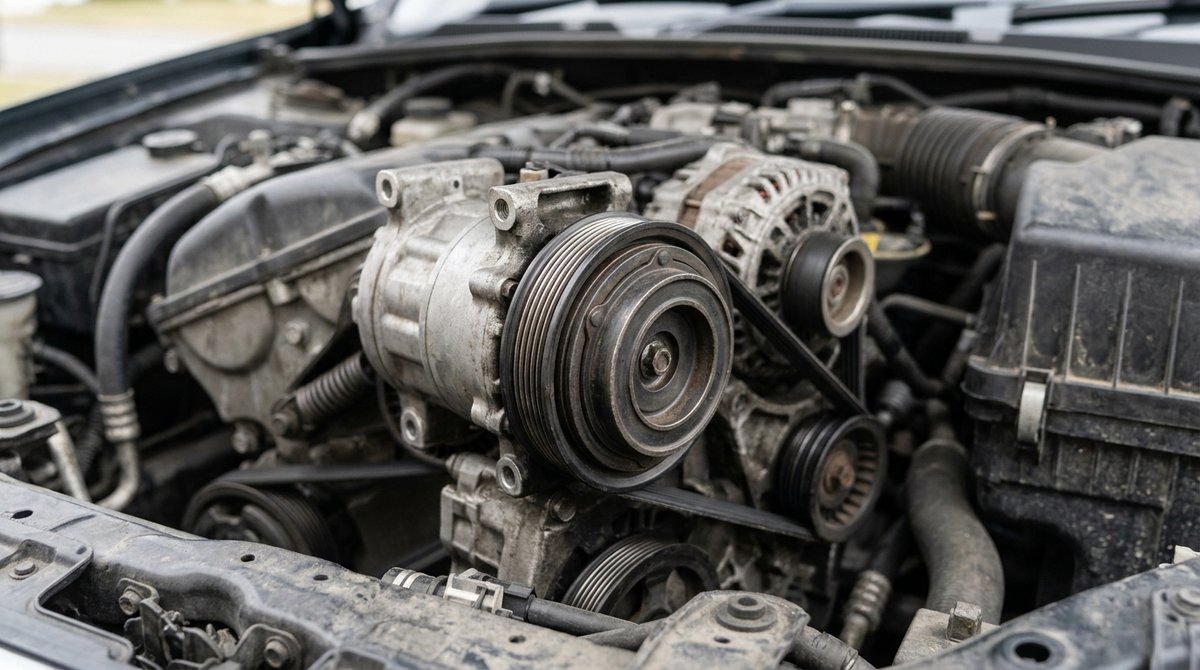
If your car squeals when AC is on but stays quiet when you switch it off, the air conditioning is adding just enough load to expose a weak spot in the belt drive. The AC compressor is one of the hardest things the engine has to turn, and when its clutch engages, a worn belt or tired tensioner can slip for a moment and squeal.
In this guide
| What you notice | Most likely cause | First check |
|---|---|---|
| Short squeal when the AC kicks in, then quiet | Worn or loose serpentine belt | Inspect the belt |
| Squeal with AC on, worse when accelerating | Weak belt tensioner | Watch the tensioner arm |
| Squeal or grinding from the compressor area, even with AC off | Worn compressor clutch or pulley bearing | Listen at the compressor |
| Loud squeal, AC not cooling, belt hot or smoking | Seizing AC compressor | Turn the AC off and get it checked |
| Chirp or squeal that follows engine speed | Worn idler pulley or misaligned pulley | Spin the idler with the belt off |
Why a car squeals when AC is on
1. A worn or glazed serpentine belt
Belts harden and lose grip with age. A glazed belt might cope with the alternator and water pump, but when the AC clutch engages and the compressor starts to turn, it slips and squeals. Look for cracks across the ribs, a shiny surface, or frayed edges. A worn belt often squeals on cold mornings too, which our guide to a car that squeals when starting in the cold covers.
2. A weak belt tensioner
The automatic tensioner keeps the belt tight. As its spring weakens, the belt loosens under heavy load. With the engine running, watch the tensioner arm when someone turns the AC on. If it jumps or bounces a lot, the tensioner is likely worn. A tensioner that rattles or grinds on its own also needs replacing. The same slip often shows up as a squealing noise when accelerating.
3. A failing compressor clutch
The compressor has an electromagnetic clutch on its front pulley. If the clutch plate slips as it engages, you hear a squeal or chirp every time the AC kicks in. A clutch that cycles on and off rapidly can add to it, which overlaps with an AC compressor clicking on and off.
4. A worn compressor pulley bearing
The compressor pulley spins whenever the engine runs, even with the AC off. A worn bearing usually makes a squeal, rumble, or grinding noise that may change when the AC is switched on. If it fails completely, the pulley can wobble and damage the belt.
5. A seizing compressor
A compressor that’s failing inside becomes very hard to turn. The belt squeals loudly or even smokes when the AC engages, and the air may stop getting cold. Switch the AC off and have it checked before the belt is damaged. Our guide to a car AC compressor not working explains the signs.
6. A worn idler pulley or misaligned pulley
Idler pulleys guide the belt around the engine. A worn bearing can chirp or squeal, and a pulley that’s slightly out of line makes the belt rub on one edge. Extra AC load makes both noises louder.
7. Too much refrigerant
An overcharged system runs at high pressure, which makes the compressor harder to turn and the belt more likely to slip. This sometimes happens after a DIY recharge from a can.
How to narrow it down
- Switch the AC on and off with the engine idling. A squeal that starts and stops with the AC points to belt slip or the clutch.
- With the engine off, inspect the belt for cracks, glazing, and fraying, and check how firm it feels.
- With the engine running and the AC on, watch the tensioner arm and the compressor’s front clutch from a safe distance. Keep hands, hair, and loose clothing well away from the belt.
- A mechanic can spray a little water on the ribbed side of the running belt. If the squeal briefly stops, the belt is slipping. If it gets louder, a pulley may be misaligned.
If a warning light is on as well, look up the code in our OBD2 code lookup, or use the car symptom checker for related symptoms. A slipping belt can also make the battery light come on when accelerating.
How much does it cost to fix?
| Repair | Typical cost (parts and labor) |
|---|---|
| Serpentine belt | $100–$250 |
| Belt tensioner | $150–$350 |
| Idler pulley | $100–$250 |
| AC compressor clutch | $300–$700 |
| AC compressor (with recharge) | $800–$1,800 |
| Correcting an overcharged system | $100–$250 |
Any repair that opens the refrigerant system has to be done by a certified technician under EPA rules for vehicle AC servicing.
Is it safe to drive?
A brief squeal when the AC engages is usually safe in the short term, but fix it soon. On most engines one belt also drives the alternator, water pump, and power steering. If a slipping belt or a seized compressor breaks it, you can lose power steering and the engine can overheat. If the squeal is loud or constant, or you smell burning rubber, keep the AC off until it’s repaired. Belts usually give warning signs before they break, so a squeal that gets worse week by week shouldn’t be ignored.
FAQ
Why does my car squeal only when the AC is on?
The compressor adds a big load to the belt. A belt or tensioner that’s slightly worn grips fine without that load but slips when the AC clutch engages.
Can I drive with the AC off to avoid the squeal?
Yes, as a short-term fix. But if the noise comes from the compressor pulley bearing, it spins even with the AC off and can still fail.
Does belt dressing fix the squeal?
It may quiet it briefly, but it doesn’t fix a worn belt or a weak tensioner, and some dressings make belts slip more over time.
Can low refrigerant make the AC squeal?
Not usually. Low refrigerant tends to make the compressor cycle on and off more often, which can cause a brief chirp each time the clutch engages, but a steady squeal points to the belt, tensioner, or compressor.