
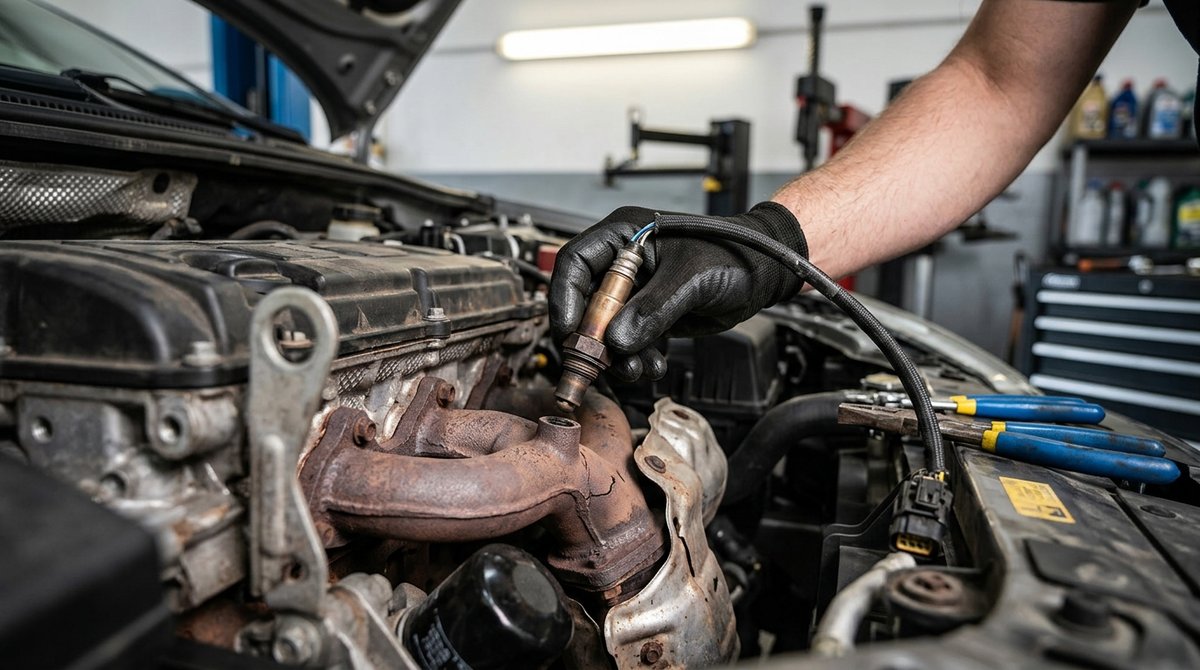
The P0135 code points to a small heating element inside one of your oxygen sensors. It’s one of the more straightforward codes to fix: in most cases the sensor itself has failed and needs replacing, which is a job many owners can do in their driveway with the right socket. It also tends to show up in cold weather, when the heater has the most work to do.
In this guide
Quick answer
| Question | Short answer |
|---|---|
| Full name | O2 Sensor Heater Circuit Malfunction (Bank 1 Sensor 1) |
| What it means | The heater in the upstream oxygen sensor on bank 1 isn’t working properly |
| Most common cause | Failed heater element inside the sensor |
| Other causes | Blown fuse, damaged wiring or connector |
| Symptoms | Check engine light, sometimes slightly worse fuel economy after cold starts |
| Safe to drive? | Yes, short term |
| Typical cost | $150–$400 at a shop, $40–$150 DIY |
What “bank 1 sensor 1” means
Bank 1 is the side of the engine that contains cylinder 1. On a four-cylinder engine there’s only one bank. Sensor 1 is the upstream oxygen sensor, the one before the catalytic converter. It measures oxygen in the exhaust so the engine computer can fine-tune the fuel mixture.
Oxygen sensors only work when they’re very hot. The built-in heater gets them up to temperature within a minute or so of a cold start, so the computer can start using their readings quickly. If the heater fails, the sensor warms up slowly, the computer runs on a less precise fuel setting for longer, and it sets P0135.
Common causes of a P0135 code
1. A failed heater element
This is the most common cause by far. The heater is a thin wire inside the sensor, and repeated heating and cooling eventually breaks it. Cold climates and older, high-mileage sensors see this most often.
2. A blown fuse
The oxygen sensor heaters usually run through a fuse. If it blows, you may see heater codes for more than one sensor at the same time.
3. Damaged wiring or connector
The sensor’s wiring runs close to the hot exhaust. Melted insulation, a corroded connector, or a wire chafed through can interrupt the heater circuit.
4. Engine computer problems
Rare, but possible if the sensor, fuse, and wiring all test fine.
How to diagnose it
- Check the fuse for the oxygen sensor heaters.
- Inspect the wiring and connector for melting, chafing, or corrosion.
- Measure the heater resistance at the sensor’s connector with a multimeter. Check your service manual for the exact spec; most heaters read only a few ohms, and an open circuit (no reading) confirms the heater has failed.
- Check for power. With the key on, the heater circuit should get battery voltage from the fuse.
- Check for related codes. P0141 is the same fault on the downstream sensor, and P0155 is the upstream sensor on bank 2. You can look them all up in our OBD2 code lookup.
P0135 vs. other oxygen sensor codes
Oxygen sensor codes follow a pattern, which makes them easier to read once you know it.
| Code | Meaning |
|---|---|
| P0130 | Oxygen sensor circuit problem (bank 1, sensor 1) |
| P0133 | Slow response from the oxygen sensor (bank 1, sensor 1) |
| P0135 | Heater circuit problem (bank 1, sensor 1) |
| P0141 | Heater circuit problem (bank 1, sensor 2, downstream) |
| P0155 | Heater circuit problem (bank 2, sensor 1) |
| P0161 | Heater circuit problem (bank 2, sensor 2) |
If you see several heater codes at once, a shared fuse or wiring problem is more likely than several sensors failing together. A single heater code on one sensor usually means that sensor has failed.
Replacing the sensor yourself
An oxygen sensor socket, which has a slot for the wire, makes this much easier. Sensors can be stubborn, so spraying penetrating oil on the threads first helps. Many mechanics remove them with the engine slightly warm, since the threads loosen more easily, but take care around hot exhaust parts. Most new sensors come with anti-seize already on the threads; if you add more, keep it off the sensor tip. Clear the code afterward and drive normally to confirm it stays off.
How much does it cost to fix a P0135 code?
| Repair | DIY parts | Shop price |
|---|---|---|
| Fuse | $1–$10 | $20–$50 |
| Upstream oxygen sensor | $40–$150 | $150–$400 |
| Wiring or connector repair | $10–$40 | $100–$300 |
| Diagnosis (if the cause isn’t obvious) | — | $100–$150 |
It’s worth entering your VIN in the NHTSA recall lookup too, in case a recall or extended warranty covers emissions parts on your car.
Can I keep driving with a P0135 code?
Yes, for now. A failed oxygen sensor heater doesn’t damage the engine, and most drivers don’t notice any change in how the car runs. You may see slightly worse fuel economy, mostly on short trips in cold weather.
Don’t leave it for months, though. You’ll fail an emissions inspection while the code is set, and with the check engine light already on, you won’t notice if a more serious problem appears. If you have other codes at the same time, like P0171 or P0420, fix the oxygen sensor first, since bad sensor readings can affect them. If your engine is also slow to warm up, read our P0128 code guide. Working from symptoms instead? Try the free car symptom checker.