
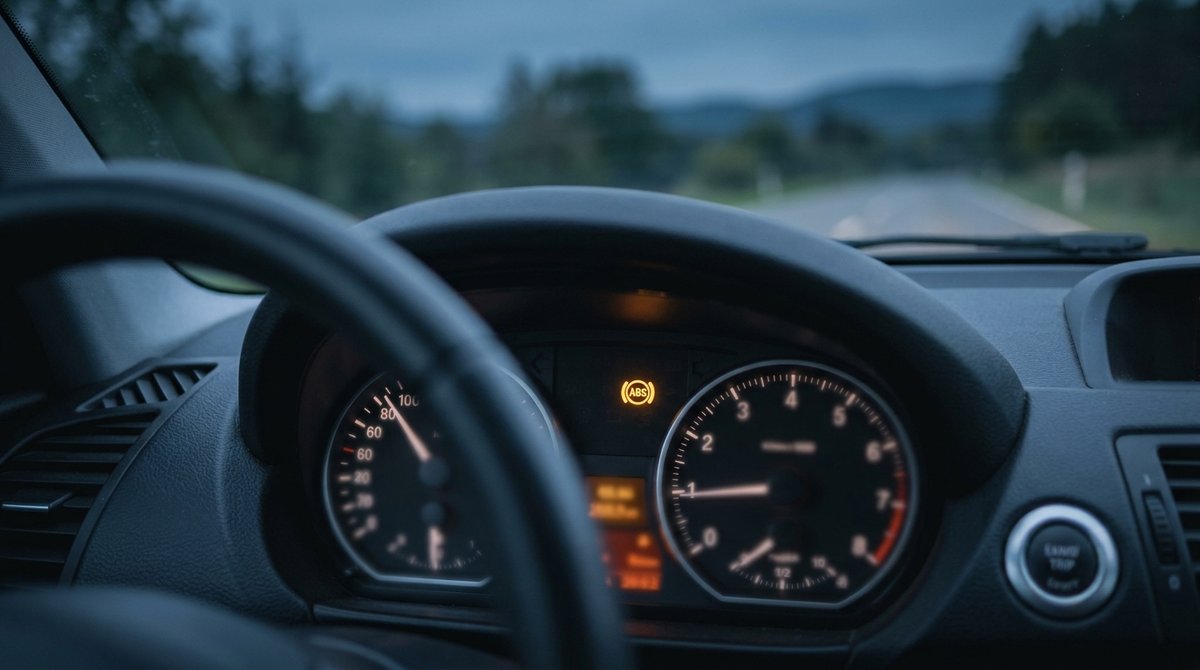
Seeing the ABS light on usually means your regular brakes still work but the anti-lock system has switched itself off. That makes it a “fix soon” warning rather than a “stop now” one, with one important exception: if the red brake light comes on with it, treat it as serious.
In this guide
| What you see | What it usually means | Urgency |
|---|---|---|
| ABS light on for a few seconds at startup, then off | Normal bulb check | None |
| ABS light stays on, brakes feel normal | ABS fault, normal braking still works | Fix soon |
| ABS and traction control lights on together | Wheel speed sensor or ABS module fault | Fix soon |
| ABS light plus red brake light | Low brake fluid or brake distribution fault | Stop driving |
| ABS light after a jump start or with a weak battery | Low voltage | Recheck after charging |
What it means when the ABS light is on
The anti-lock braking system (ABS) watches how fast each wheel is turning. If one wheel slows much faster than the others during hard braking, the system pulses that brake so the tire keeps grip and you can still steer. When it detects a fault, it turns itself off and lights the warning. Your brakes then work like a car without ABS, so wheels can lock and skid in a panic stop, especially on wet or icy roads. On most modern cars, traction control and stability control use the same sensors, so their lights often come on at the same time.
7 common causes of an ABS light on
1. A faulty wheel speed sensor
This is the most common cause by far. Each wheel has a sensor that sits close to a toothed ring. Road grime, brake dust, rust, or a damaged wire can stop it reading. Sensors fail more often on cars that see salt and slush. They’re also easy to damage during brake or suspension work, so if the light came on right after a brake job, check the sensor and its wire at that wheel first.
2. A damaged tone ring
The toothed ring that the sensor reads can crack, rust, or lose teeth, especially on older cars. The sensor then sees an irregular signal and sets a fault. On many front-wheel-drive cars, the front ring is part of the CV axle, so the fix can mean replacing the whole axle.
3. A worn wheel bearing
On many cars the sensor or its ring is built into the wheel hub. A bearing with play lets the gap change, which confuses the sensor. If you also hear a growl or grind that rises with speed, see our guide to a grinding noise while driving. A worn bearing that has started to upset the sensor often also causes a humming noise when driving.
4. Low brake fluid
Some cars light the ABS warning when the fluid drops, usually together with the red brake warning light. Low fluid means worn pads or a leak, and both need checking.
5. Low battery voltage
The ABS module needs steady voltage. A weak battery, a failing alternator, or a recent jump start can trigger the light. The ABS light may clear by itself after a few drives once the voltage is steady. If the battery light is on while driving too, start there.
6. A blown fuse or relay
The ABS pump motor has its own high-current fuse and relay. If one fails, the system shuts down. It’s a cheap check worth doing early.
7. A failing ABS module or pump
This is the expensive one. The control module or the hydraulic unit can fail internally. It’s less common, so rule out sensors, wiring, and voltage first.
How to diagnose it
A basic OBD2 scanner reads engine codes but often can’t see the ABS module. ABS faults use codes that start with C, so you need a scanner that supports ABS, or a shop that has one. With a capable scanner, live data shows the speed of each wheel while you drive slowly, and a sensor reading zero or jumping around is your culprit. Our OBD2 code lookup can decode engine codes if the check engine light is on as well, and the car symptom checker helps if you have other symptoms.
Before paying for diagnosis:
- Check the brake fluid level against the MIN and MAX marks.
- Check that all four tires are the same size and properly inflated, since a mismatched spare can confuse the system.
- If the battery was recently flat, drive for a while after charging and see whether the light clears.
How much does it cost to fix?
| Repair | Typical cost (parts and labor) |
|---|---|
| ABS diagnostic scan | $0–$150 |
| ABS fuse or relay | $5–$100 |
| Wheel speed sensor | $100–$300 |
| Tone ring | $150–$500 |
| Hub assembly with built-in sensor | $200–$600 |
| ABS module (rebuilt or replaced) | $300–$2,000+ |
Is it safe to drive with the ABS light on?
With only the ABS light on and a firm pedal, you can usually drive carefully to a shop. Leave extra following distance and brake earlier, especially in rain or snow, because the wheels can lock in a hard stop. Don’t drive if the red brake light is also on, the pedal feels soft or sinks (see brake pedal goes to the floor), or the car pulls hard when braking. In some US states, a lit ABS light can also fail a safety inspection. Some ABS and sensor problems are covered by recalls, so check the NHTSA recall lookup before paying for a module.
FAQ
Will the ABS light turn off by itself?
Sometimes, if the cause was low voltage or a sensor that cleaned itself. A light that stays on after a few drives needs a scan.
Can low brake fluid cause the ABS light?
Yes, on some cars. It usually turns on the red brake warning light as well.
Is a pulsing brake pedal a sign of ABS trouble?
Not on its own. Pulsing during a hard stop on a slippery road is the ABS working. Pulsing during every gentle stop is more likely warped rotors.
Can I reset the ABS light myself?
An ABS-capable scanner can clear the code, but the light will come back if the fault is still there. Disconnecting the battery may also clear it temporarily. Fix the cause first, then clear the code.