
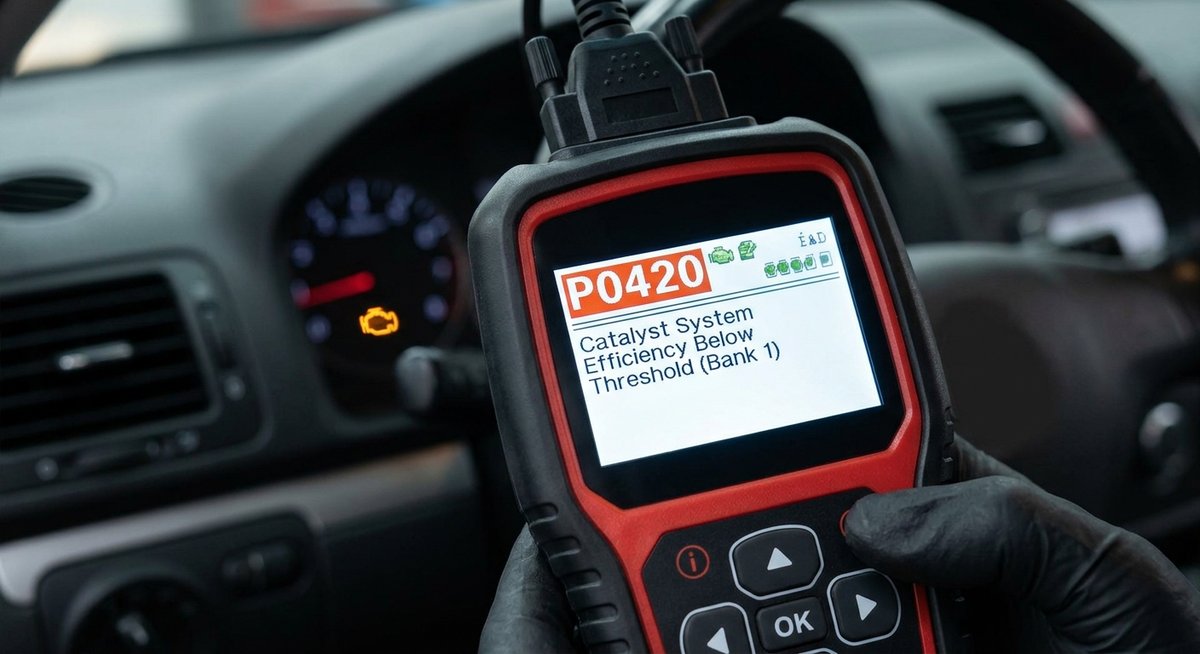
The P0420 code is one of the most common check engine codes there is, and also one of the most expensive to get wrong. Plenty of people have replaced a $1,200 catalytic converter only to see the light come back a week later, because the converter was never the real problem.
In this guide
This guide explains what the code means, how to tell whether your converter is actually dead, and what to check before you spend serious money.
What P0420 means
The full definition is “Catalyst System Efficiency Below Threshold (Bank 1).” Your car has an oxygen sensor before the catalytic converter and another one after it. The computer compares the two readings. A healthy converter stores and releases oxygen as it cleans the exhaust, so the downstream sensor should show a fairly steady signal while the upstream one swings up and down.
When the downstream sensor starts swinging almost as much as the upstream one, the computer decides the converter isn’t doing its job and sets P0420. Bank 1 is the side of the engine with cylinder number 1. On a four-cylinder car there’s only one bank. On a V6 or V8, the other side gets its own code, P0430. If your scanner lists P0420 as pending rather than stored, our guide to pending vs stored vs permanent codes explains what that means.
Can you keep driving?
Yes. P0420 won’t leave you stranded or damage the engine. Two caveats: your car will fail an emissions inspection where they’re required, and if the converter is genuinely clogged (rather than just inefficient), you’ll feel a loss of power and may smell rotten eggs.
If the check engine light is flashing rather than steady, that’s a different situation. Read our guide on a flashing check engine light and stop driving.
It’s also worth entering your VIN in the NHTSA recall database; if a recall covers the part, the dealer fixes it for free.
What actually causes P0420
In rough order of how often each one turns out to be the answer:
A worn-out converter
Catalytic converters do wear out, typically somewhere past 100,000 miles. The precious-metal coating inside degrades and stops converting pollutants efficiently. If your car has high mileage and no other codes, this is the likely answer.
A converter that was killed by something else
This is the one that costs people money twice. Misfires send raw fuel into the exhaust, where it burns inside the converter and melts the honeycomb. An engine burning oil or coolant coats the catalyst and poisons it. A rich fuel mixture does similar damage more slowly.
If you replace the converter without fixing the misfire or the oil burning, the new one dies the same way. Look for other codes stored alongside P0420, especially misfire codes in the P0300 range or rich codes like P0172. If P0420 shows up alongside an EVAP code, our P0455 code guide covers that one separately. If you also have a P0128 code, fix the thermostat first, since an engine that runs cold is hard on the catalytic converter. Small EVAP leaks often show up alongside it; see our P0442 code guide.
A lazy downstream oxygen sensor
Oxygen sensors age too. A slow or contaminated downstream sensor can report a swinging signal even when the converter is fine. This is the cheap fix, and it’s worth ruling out first because a sensor is $150 to $400 versus $500 to $2,500 for a converter.
An exhaust leak
A leak between the engine and the downstream sensor lets fresh air into the exhaust stream, which fools the sensor into reading lean and erratic. Cracked manifolds, failed gaskets and rusted flex pipes are the usual culprits. You can often hear a leak as a ticking at cold start.
Wrong or low-quality parts
Cheap aftermarket converters sometimes don’t hold enough catalyst to satisfy the computer, and some cars are notoriously picky. If P0420 appeared shortly after a budget converter was installed, that’s probably why.
How to diagnose it before buying anything
You or a mechanic can narrow this down in under an hour with a scan tool that shows live data.
- Check for other codes. Misfire, lean, rich or oxygen sensor codes change the whole picture. Fix those first, clear everything, and see if P0420 returns.
- Watch the oxygen sensor voltages. With the engine warm and idling, the upstream sensor should swing between roughly 0.1 and 0.9 volts several times a second. The downstream sensor should sit fairly flat, usually around 0.6 to 0.7 volts. If the downstream sensor mirrors the upstream one, the converter has stopped storing oxygen.
- Listen and look for exhaust leaks. Cold engine, hand near the manifold and joints (carefully), listening for ticking or puffing.
- Check the oil and coolant. Dropping oil level with no leak means the engine is burning it. Coolant disappearing with no leak points to a head gasket. Either one will kill a new converter.
Many shops do this diagnostic for $80 to $150, and it’s money well spent against the price of the part.
P0420 code: what the fix costs
| Fix | Typical cost (US) |
|---|---|
| Downstream oxygen sensor | $150 – $400 |
| Exhaust leak repair (gasket, flex pipe) | $150 – $500 |
| Aftermarket catalytic converter, installed | $500 – $1,200 |
| OEM or CARB-compliant converter, installed | $1,200 – $2,500+ |
A few things to know before buying a converter:
- Check your warranty first. In the US, federal law requires the catalytic converter to be covered for 8 years or 80,000 miles. If your car is inside that window, the dealer replaces it for free.
- California and some other states require CARB-approved converters. They cost more, and a non-approved part can fail inspection. Check your state’s rules.
- Skip the “catalytic converter cleaner” bottles. At best they help a converter that’s lightly coated with carbon. They won’t restore a worn-out or melted one, and the light usually comes back within a few hundred miles.
Can you just clear the code?
You can, but it comes back. The computer runs the catalyst test every drive cycle once the engine is warm, so a bad converter trips the code again within a few days. Clearing also resets your emissions readiness monitors, which means the car will fail an inspection as “not ready” until you’ve driven enough for the tests to complete.
The short version
Don’t buy a converter on the code alone. Rule out other codes, check the downstream sensor and look for exhaust leaks. If the converter really is worn, make sure nothing is burning oil or misfiring before the new one goes in, or you’ll be doing this again. An oxygen sensor heater fault like a P0135 code should be fixed before chasing a catalytic converter code.
Have another code stored with it? Look it up in our OBD2 Code Lookup.