
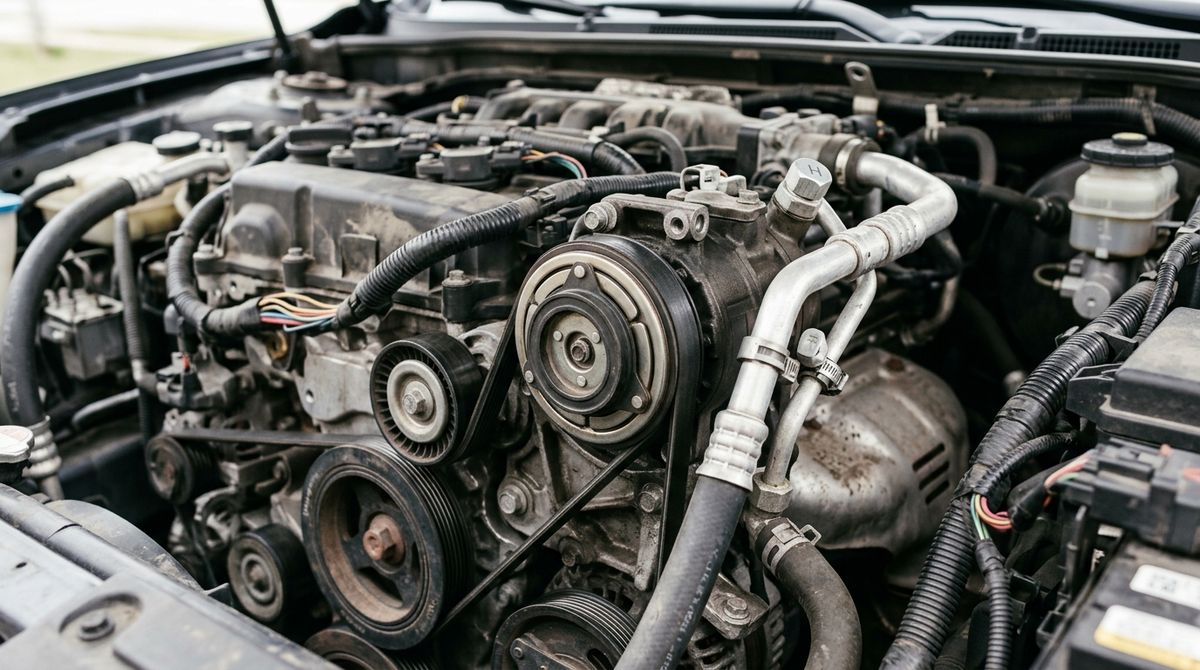
When you have a car AC compressor not working, the whole system suffers, because the compressor is the heart of your car’s air conditioning. It squeezes the refrigerant and pushes it around the system, and when it stops, you get warm air no matter where you set the dial. The frustrating part is that “compressor not working” has a lot of possible meanings, and only some of them involve the compressor itself.
In this guide
This guide walks through how to tell what’s going on and what each fix costs. If your AC blows cool but not cold, or works on one side only, start with our guides on AC not blowing cold and AC hot on one side instead. If the compressor works but the air smells stale or moldy, read car AC smells musty. If the AC cools while driving but not when stopped, see car AC not cold at idle first.
First, watch the clutch
Most compressors have a clutch on the front. The pulley spins any time the engine runs, but the center plate only spins when the clutch engages and the compressor is actually working. If the compressor runs but you hear a squeal when it kicks in, see why a car squeals when the AC is on.
Start the engine, turn the AC to max cold with the fan on high, open the hood and look at the front of the compressor. You should see the center plate snap in with a click and spin with the pulley. It may cycle on and off every 10 to 30 seconds, which is normal. If you hear the compressor engaging and disengaging every few seconds, read AC compressor clicking on and off.
- Clutch engages and spins: the compressor is turning. If the air is still warm, the problem is elsewhere (low refrigerant, a blend door, a blockage).
- Clutch never engages: something is preventing it. This is the most common complaint, and the compressor itself is often fine.
- Clutch engages but the pulley squeals or the engine bogs down: the compressor is seizing.
- Clutch rattles or grinds: the compressor bearing or internals are failing.
Note that some newer cars use a clutchless variable-displacement compressor that spins all the time. On those, you’ll need gauges or a scan tool to see what it’s doing. If the compressor runs but the air is only cool, read car AC not cooling enough.
The 7 causes
1. Low refrigerant
The system has a low-pressure switch that refuses to engage the clutch if there isn’t enough refrigerant, because running a compressor without refrigerant (and the oil carried in it) destroys it. So a slow leak, over a season or two, ends with a clutch that simply won’t click on.
This is the most common cause of a compressor that “doesn’t work.” A shop will recover what’s left, check for leaks with dye or an electronic sniffer, repair the leak and recharge by weight.
Cost: $150 to $300 for an evacuate-and-recharge with a leak check. Repairing the leak adds whatever the leaking part costs: an O-ring is cheap, a condenser is $400 to $900.
A word on DIY recharge cans: they’re legal for the older R-134a refrigerant in the US and tempting at $30 to $50, but it’s easy to overcharge, which hurts cooling and stresses the compressor. And if the system is low, there’s a leak; adding refrigerant without finding it is a short-term patch. Newer cars with R-1234yf need professional equipment.
2. Blown fuse or failed relay
The compressor clutch is powered through a fuse and a relay, usually in the under-hood fuse box. Check the fuse first. If it’s blown, replace it once; if it blows again, there’s a short, often in the clutch coil. Relays can be swapped with an identical one from a less important circuit (like the horn) to test.
Cost: $5 to $25 for parts if you do it yourself.
3. Failed clutch coil or excessive air gap
The clutch engages when an electromagnet pulls the center plate against the pulley. If the coil burns out, nothing happens. If the gap between the plate and pulley grows too wide from wear, the magnet can’t pull it in, especially when hot. A quick test: if the AC works when the engine is cold but quits once everything heats up, a wide air gap is the usual reason. If the compressor works at first but drops out once the engine is hot, see car AC blows cold then warm. A clutch that slips only at higher engine speeds is a common reason the AC blows hot air when driving.
Some clutches can be replaced separately; on many modern cars the clutch and compressor come as one unit.
Cost: $300 to $600 for a clutch assembly where available; otherwise it’s a compressor replacement.
4. Faulty pressure switch or sensor
The low- and high-pressure switches tell the computer whether it’s safe to run the compressor. A failed switch says “no” regardless of the real pressure. A shop can check actual pressures with gauges and compare them with what the switch is reporting.
Cost: $100 to $300.
5. Electrical or control module fault
The AC request goes from your dash control to the body or climate module, to the engine computer, to the relay. A broken wire, a corroded connector or a failed module anywhere along that chain stops the clutch from getting its signal. Climate control codes read with a scan tool usually point to the failing part.
Cost: $100 to $300 for diagnosis; wiring repairs are usually modest, modules are $300 to $1,000.
6. Seized or failing compressor
Compressors do fail, usually from running low on refrigerant and oil, or simply from age. A seized compressor squeals the belt or stalls the engine when the clutch engages. A failing one grinds, leaks oil around its body, or just won’t build pressure even though it spins.
When a compressor fails internally, it sends metal debris through the system. A proper repair replaces the compressor, the receiver-drier or accumulator, and usually the expansion valve or orifice tube, then flushes the lines. Skipping the flush is how a new compressor fails in six months.
Cost: $800 to $1,500 for most cars; $1,500 to $2,500+ for luxury vehicles or when the condenser also needs replacing.
7. Serpentine belt problems
If the belt that spins the compressor pulley is worn, loose or missing, the compressor can’t run. You’d usually notice other symptoms too, like a squealing noise, a battery light or heavy steering, because the same belt drives the alternator and power steering pump.
Cost: $75 to $200 for a belt.
Car AC compressor not working: can you drive with a bad AC compressor?
If the clutch simply won’t engage, yes, you’ve just lost the AC. If the compressor is seizing, it’s a different matter: a locked compressor can shred the serpentine belt, and on most cars that belt also drives the water pump and alternator. Leave the AC switched off and get it fixed, or have the belt rerouted with a bypass pulley if you’re deferring the repair. Your defroster uses the AC to dry the air, so a dead compressor can leave the windshield fogged; see defroster not working.
It’s also worth entering your VIN in the NHTSA recall database; if a recall covers the part, the dealer fixes it for free.
What to tell the shop
Describe exactly what you observed: whether the clutch engages, any noises, whether cooling fades when hot, and when it started. Ask for the system pressures and whether a leak was found. If a compressor is recommended, ask whether the drier and expansion valve are included and whether the system will be flushed. Those two questions separate a repair that lasts from one that doesn’t.
Not sure the compressor is even the problem? Our Car Symptom Checker can help narrow it down.