
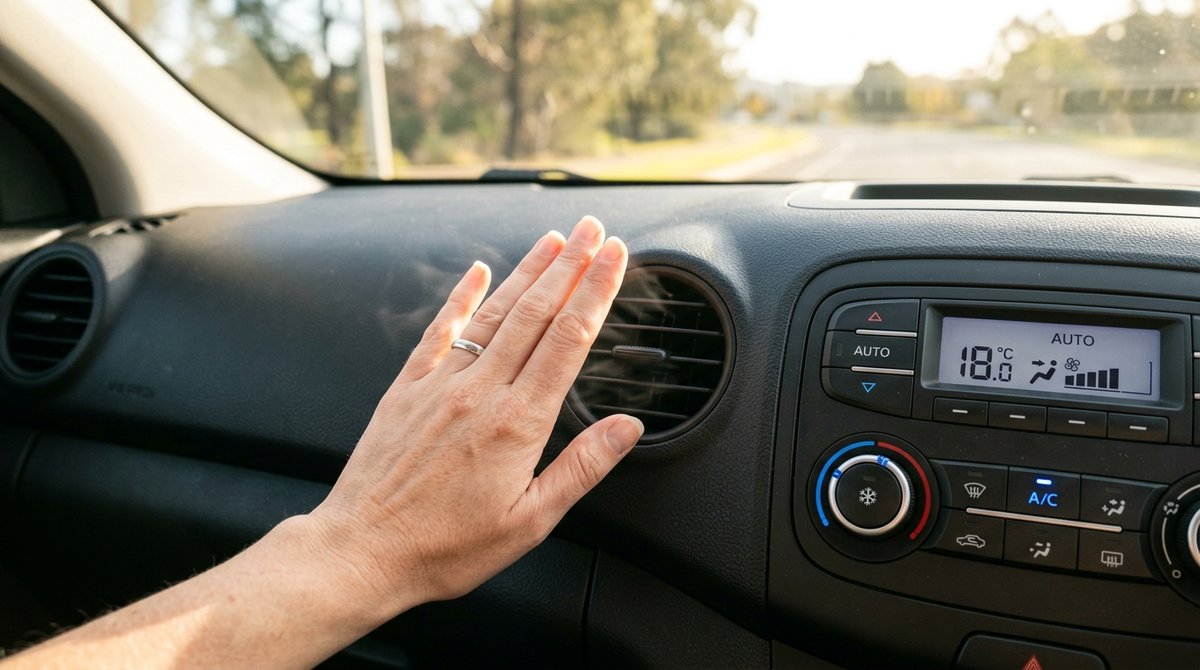
It starts out great. You pull away, the vents blow ice-cold air, and twenty minutes later it’s barely cooler than the air outside. When a car AC blows cold then warm like this, the system isn’t dead. Something is making it cut out or lose its grip partway through the drive, and the timing of the switch is your best clue to what it is. If it never gets cold in the first place, see car AC not cooling enough.
In this guide
Quick answer
| What you notice | Likely cause |
|---|---|
| Cold at first, warm after 15–30 minutes, airflow stays strong | Compressor clutch dropping out when hot, or low refrigerant |
| Airflow gets weaker as it warms up, then cold returns later | Evaporator freezing over |
| Warm at stoplights, cold again once you’re moving | Cooling fan or condenser problem |
| Temperature drifts warm on one side or at random | Blend door actuator |
| Warm after a long climb or hot traffic, temp gauge high | Engine running hot, AC switched off to protect it |
Why the cold air doesn’t last
Your AC works as a loop. The compressor squeezes refrigerant, the condenser at the front of the car dumps heat, and the evaporator behind the dashboard gets cold and chills the air blowing over it. On a healthy system that loop keeps up all day. When one part is marginal, it copes for a while, then falls behind once everything heats up or ices over.
7 common causes
1. Low refrigerant
This is the most common one. With a borderline charge, the system cools at first, then pressures drift out of range and the compressor starts shutting off more often. Refrigerant doesn’t get used up like fuel, so low refrigerant always means a leak somewhere. If you’ve noticed the cooling getting a little weaker each summer, this fits.
2. A freezing evaporator
If the air gets colder and colder, then the airflow weakens and turns warm, the evaporator has probably iced over. Ice blocks the air from passing through. Try this: switch the AC off, leave the fan on high for ten minutes, then turn the AC back on. If it blows cold again, freezing is your problem. Low refrigerant, a clogged cabin air filter, a faulty evaporator temperature sensor, or moisture in the system can all cause it.
3. A compressor clutch that drops out when hot
The front of the compressor has an electric clutch that locks it to the spinning pulley. As the clutch wears, the gap between its plates grows, and once the engine bay heats up the magnet can’t pull it in anymore. With the engine running and AC on max, carefully look at the center plate on the front of the compressor. It should spin with the pulley. If it stops right when the air turns warm, you’ve found it. Keep hands, hair and sleeves well away from the belts and fan.
4. A cooling fan or condenser problem
The condenser needs air flowing through it to get rid of heat. At speed, the wind does that job. At a stoplight, it’s all down to the electric fan. If the fan is weak or dead, or the condenser is caked with bugs and leaves, the AC goes warm at idle and recovers once you’re moving. We cover this pattern in detail in car AC not cold at idle. If the change happens as soon as you speed up rather than after a while, see why the AC blows hot air when driving.
5. A failing blend door actuator
A small motor behind the dashboard mixes hot and cold air to hit the temperature you set. When it fails, it can drift toward hot, often with a clicking or tapping sound from behind the dash. If one side of the car is warmer than the other, read AC blowing hot air on driver side.
6. The engine is running hot
Many cars switch the AC compressor off automatically when coolant temperature climbs, because the AC adds load and heat. If the air turns warm at the same moment the temperature gauge rises, the cooling system is the real problem. See car overheating then going back to normal.
7. Too much refrigerant, or moisture in the system
This one often follows a DIY recharge. Overfilling pushes pressures too high, so the system shuts the compressor off to protect itself. Moisture inside the lines can also freeze at the expansion valve and block flow for a while, then thaw and let it cool again.
Quick checks you can do yourself
- Time it. Note how long it stays cold and whether it fails at idle, on the highway, or both.
- Check the cabin air filter. A clogged one cuts airflow and can help the evaporator freeze.
- Watch the compressor clutch as described above.
- Look at the cooling fan with the engine idling and AC on. On most cars, at least one fan should run whenever the AC is on.
- Do the freeze test from cause #2.
A word on DIY recharge cans: they’re only an option if your car uses R-134a, so check the sticker under the hood first, since many newer cars use R-1234yf with different fittings. Use a can with a gauge and never fill past the recommended range. It’s a temporary fix at best, because the leak is still there. When a shop opens the system, refrigerant has to be recovered with approved equipment rather than vented into the air; the EPA’s rules for AC servicing explain what a proper shop should be doing.
Car AC blows cold then warm: repair costs
| Repair | Typical cost |
|---|---|
| Cabin air filter | $15–$60 |
| Leak test and recharge (R-134a) | $150–$300 |
| Leak test and recharge (R-1234yf) | $250–$600 |
| Leak repair (O-ring, hose, valve core) | $100–$500 |
| Blend door actuator | $150–$500 |
| Cooling fan motor | $300–$800 |
| Compressor clutch or AC relay | $150–$700 |
| Expansion valve or orifice tube | $250–$650 |
| Compressor replacement | $900–$2,000 |
Can I keep driving?
Yes. Warm air is uncomfortable, not dangerous, and none of these faults will damage the engine on their own. There are three exceptions worth taking seriously.
If the air turns warm at the same time the temperature gauge climbs, deal with the cooling system first. If the compressor makes a grinding or rattling noise, switch the AC off; a seizing compressor can shred the drive belt, and on many cars that belt also runs the alternator and water pump (see squealing noise when accelerating). And in real heat, a car with no working AC can get dangerously hot for kids, pets, and older passengers.
If the air is cold but smells damp, that’s a separate issue covered in car AC smells musty. AC faults rarely set a check engine code, but if your light is on too, look it up in our OBD2 code lookup. Still not sure what you’re dealing with? Try the free car symptom checker.