
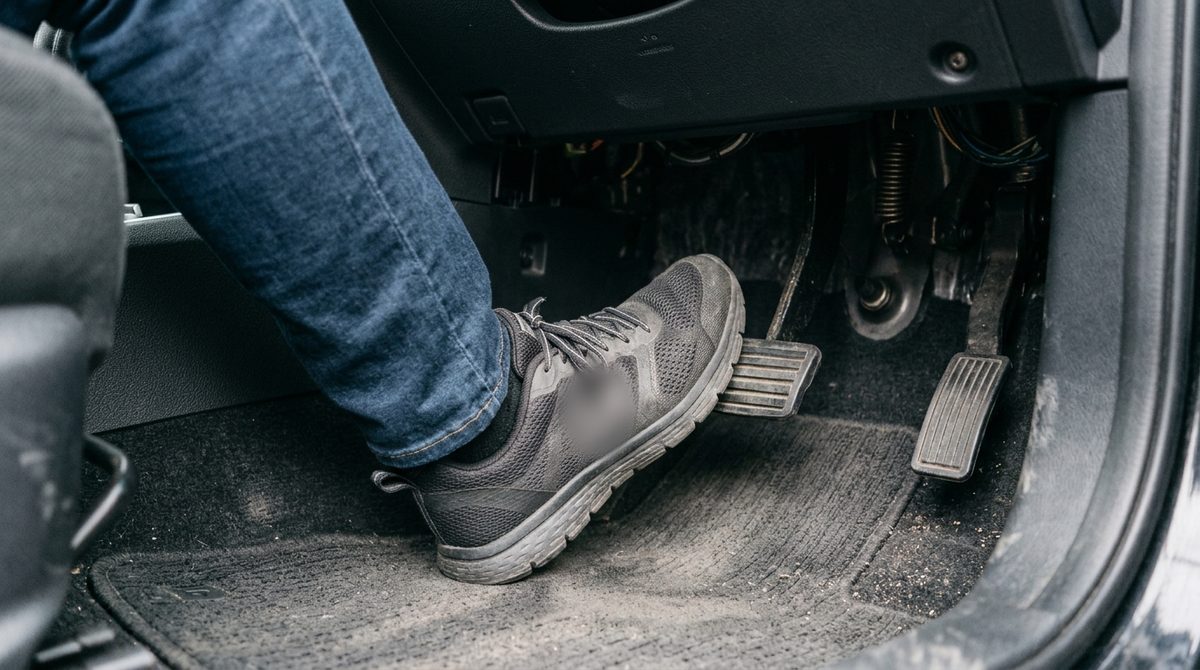
A brake pedal hard to press, one that feels stiff like a brick and needs your full leg to slow the car, usually means the brake booster isn’t helping you. The booster uses engine vacuum to multiply the force of your foot, so when it loses vacuum, the brakes still work but need far more effort. That makes this a problem to fix right away, not one to live with.
In this guide
| What you notice | Most likely cause | Urgency |
|---|---|---|
| Pedal hard only with the engine off | Normal, the booster needs the engine running | None |
| Pedal hard with the engine running, car slows poorly | Failing brake booster or vacuum supply | High |
| Hissing under the dash when you press the pedal | Booster diaphragm leak | High |
| Stiff pedal plus rough idle or lean code | Vacuum hose leak | High |
| Pedal gets harder after several presses in a row | Leaking check valve or weak vacuum | High |
| Pedal firm but the car barely slows, burning smell | Seized caliper or glazed pads | High |
Brake pedal hard to press: 6 common causes
1. The engine is off
With the engine off, the booster has enough vacuum stored for a press or two, then the pedal goes hard. That’s normal and explains a stiff pedal when the car is parked or after a stall.
2. A failing brake booster
The booster is the large round canister behind the master cylinder, on the driver’s side of the firewall. Its internal diaphragm can tear with age. You’ll feel a hard pedal, the car will need much more effort to stop, and you may hear a hiss from under the dashboard when you press the brake. A leaking booster can also make the idle rough, because it’s effectively a large vacuum leak. Boosters usually fail gradually, so a pedal that has been getting stiffer over a few weeks is a typical pattern.
3. A leaking vacuum hose or check valve
A thick rubber hose carries vacuum from the engine to the booster, with a one-way check valve in it. A cracked hose or a stuck valve means the booster can’t hold vacuum. A large vacuum leak can also make the engine run lean and set a P0171 code.
4. Low engine vacuum or a failed vacuum pump
Many diesel and some turbocharged or direct-injection gasoline engines don’t make enough vacuum on their own, so they use a separate vacuum pump. If it fails, the pedal goes hard. An engine that’s running badly may also produce weak vacuum. On cars with a vacuum pump, a warning light or a code for low brake booster vacuum may appear as well.
5. A seized caliper or glazed pads
Sometimes the pedal feels normal or firm, but the car simply doesn’t slow well. A seized caliper piston or glazed, overheated pads grip poorly, so you push harder. Look for a burning smell, one wheel running much hotter than the others, or the car pulling to one side when braking. Our guide to brake pads vs rotors explains what to check.
6. A problem in the hydraulic system
Less commonly, a collapsed brake hose or a sticking master cylinder can make the pedal feel hard or uneven. This needs a professional inspection. A seized caliper can also make the car pull to one side when braking, along with a stiff, weak feel at the pedal.
The two-minute brake booster test
- With the engine off, press the brake pedal 4–5 times until it feels hard. This empties the stored vacuum.
- Keep light, steady pressure on the pedal and start the engine.
- The pedal should drop slightly under your foot as the booster gets vacuum. That means the booster is working.
- If the pedal doesn’t move at all, the booster or its vacuum supply has a problem.
- To check that it holds vacuum, run the engine for a minute, switch it off, wait 30 seconds, then press the pedal. You should get one or two assisted presses before it goes hard.
If a brake or ABS warning light is on as well, see our guides to the brake warning light and the ABS light. Look up any engine code in our OBD2 code lookup, and use the car symptom checker if you’ve noticed other symptoms.
How much does it cost to fix?
| Repair | Typical cost (parts and labor) |
|---|---|
| Vacuum hose to the booster | $50–$150 |
| Booster check valve | $30–$100 |
| Brake booster replacement | $300–$800 |
| Vacuum pump (diesel or some gas engines) | $300–$900 |
| Caliper (one side) | $150–$400 |
| Pads and rotors (one axle) | $250–$600 |
| Master cylinder | $300–$700 |
Is it safe to drive?
No. A hard pedal means much longer stopping distances, and in an emergency you may not be able to press hard enough to stop in time. If the pedal goes hard while you’re driving, press firmly and steadily, leave much more space, and pull over somewhere safe. Have the car towed or driven slowly a short distance to a shop. The opposite problem, a pedal that sinks, is just as serious, and our guide to a brake pedal that goes to the floor covers it. Brake boosters and vacuum pumps have been recalled on some vehicles, so check the NHTSA recall lookup before paying for the repair.
FAQ
Why is my brake pedal hard when the car is off?
That’s normal. The brake booster needs engine vacuum to assist you, and it only stores enough for a press or two.
What does a bad brake booster sound like?
Often a hissing sound under the dashboard when you press the pedal, sometimes with a change in idle speed.
Can a vacuum leak cause a hard brake pedal?
Yes. If the hose to the booster leaks, the booster can’t build vacuum, and the pedal goes hard.
Can cold weather make the brake pedal hard?
A little. Rubber hoses and seals stiffen in the cold, but the pedal should feel normal within a minute of driving. A pedal that stays hard points to the booster or its vacuum supply.
Is a hard brake pedal the same as brake failure?
Not quite. The brakes still work, but they need much more force, so stopping distances get longer. Treat it as urgent.